

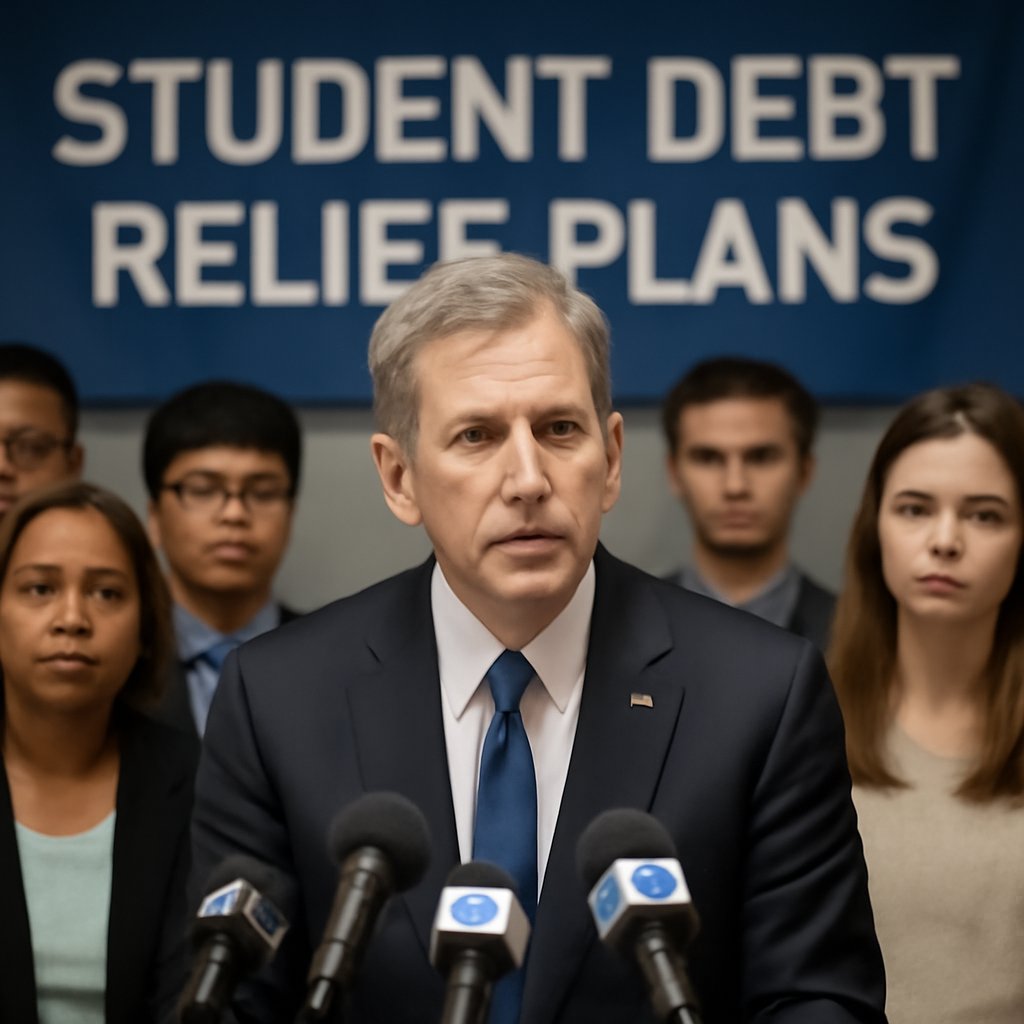
Student debt relief has become a flashpoint in federal budgeting and regulatory debates, with proposals centered on adjusting repayment formulas and targeting forgiveness for specific cohorts of borrowers. As someone who worked in policy analysis, the mechanism here is rooted in executive actions layered atop existing statutory authorities like the Higher Education Act, rather than new appropriations that would require congressional buy-in. The data behind claims of systemic inequity is actually more nuanced than reported, with Federal Reserve figures showing that while aggregate balances exceed $1.7 trillion, distribution varies sharply by degree completion and field of study.
Policy shifts dating to the 1980s and 1990s did alter the cost-sharing model for postsecondary education, moving away from direct state subsidies toward greater reliance on federal loans. This coincided with rising enrollment and tuition growth outpacing inflation by roughly 2 percentage points annually in many states, according to College Board trend data. The 2008 downturn amplified repayment stress, as unemployment for recent graduates peaked near 10 percent and wage stagnation persisted in entry-level segments, pushing default rates higher in Department of Education servicing reports.
Early expansions under the Obama administration refined income-driven repayment plans, capping payments at 10-15 percent of discretionary income and introducing forgiveness after 20-25 years. These adjustments demonstrated how incremental regulatory tweaks can alter effective debt burdens without full cancellation, though take-up rates remained below projections due to paperwork hurdles and servicer communication gaps. The Biden administration’s 2022 announcements built on this by proposing up to $20,000 in relief for Pell recipients and $10,000 for others, framed around equity metrics that align with demographic borrowing patterns.
Legal challenges ultimately narrowed the scope, with the Supreme Court striking down the broadest elements on administrative grounds. Implementation details here echo the rollout complexities seen in Affordable Care Act subsidy expansions, where eligibility verification and appeals processes created uneven coverage across states. Economic modeling from multiple sources projects that scaled relief could add roughly $108 billion to GDP over a decade via consumption and small-business formation effects, though static scoring from the Congressional Budget Office would flag the direct fiscal cost in the hundreds of billions absent offsetting revenue measures.
Targeted programs for public-service employees have already processed forgiveness for several hundred thousand borrowers through the Public Service Loan Forgiveness pathway, highlighting how narrow eligibility criteria can produce measurable outcomes when certification requirements are streamlined. Borrowers of color face default rates approximately 2.5 times higher than white borrowers on average, per Brookings Institution breakdowns, though controlling for institutional type and completion status narrows the gap. Women account for nearly 60 percent of outstanding balances, reflecting enrollment patterns in fields with variable post-graduation earnings.
Broader relief would likely influence workforce allocation toward lower-paying sectors such as education and social services, similar to how healthcare workforce incentives under the National Health Service Corps have directed providers into underserved areas. Over 45 million individuals carry federal loans with median balances above $37,000, and more than one-quarter remain delinquent, underscoring the limits of temporary forbearance periods. Proposals to extend forgiveness to community-college attendees would disproportionately reach rural and first-generation populations, though administrative capacity for verifying attendance records remains a practical constraint.
The mechanics of income-driven repayment deserve closer examination, as these plans represent the most politically viable pathway forward compared to outright forgiveness. Under the Revised Pay As You Earn (REPAYE) plan, borrowers pay no more than 10 percent of discretionary income toward undergraduate loans, with remaining balances forgiven after 20 years of qualifying payments. For graduate loans, the calculation shifts to 10 percent of all income, not just discretionary amounts, extending forgiveness to 25 years. The Congressional Budget Office estimates that these programs, as currently structured, will ultimately forgive roughly 40 percent of loans made to recent cohorts—a figure that underscores how current policy already embeds substantial debt relief through the back door, albeit with longer timelines and more stringent conditions than proposed direct cancellation.
The debate over inflation’s role in student debt stress often gets oversimplified in political discourse. While nominal tuition figures have risen sharply, the real cost to families depends heavily on whether they receive grant aid, tax credits, or employer benefits. The effective net price—what families actually pay out-of-pocket—has remained relatively stable for middle and lower-income students at four-year public institutions over the past decade, largely due to increased Pell Grant allocations and state funding adjustments. However, this stability masks divergence across institutional types: for-profit colleges and less selective private institutions have seen steeper real price increases, and these institutions serve disproportionately higher shares of first-generation and low-income students.
State-level variation in student debt outcomes presents another underappreciated dimension. Southern and Midwestern states with stronger public university systems and lower tuition structures generally show lower median debt loads, while students in northeastern and western states with higher tuition environments carry substantially larger balances. This geographic disparity suggests that a one-size-fits-all federal relief policy may not align perfectly with regional economic capacity or workforce needs. Some economists argue that targeted relief coupled with state-based cost controls would produce more durable outcomes than temporary federal forgiveness without accompanying structural reforms.
The conversation around moral hazard—whether relief encourages future overborrowing—warrants serious consideration. Federal Reserve research suggests that loan availability itself, rather than forgiveness expectations, drives enrollment and borrowing decisions. However, absent concurrent reforms to how future loans are distributed and priced, broad-based relief could theoretically shift incentives. Policy analysts across the ideological spectrum generally agree that any major relief package should be paired with constraints on future borrowing growth, such as tighter underwriting standards for graduate student loans or stricter limits on Parent PLUS borrowing, which has grown 70 percent in real terms over the past fifteen years.
The servicing infrastructure challenge cannot be overlooked when evaluating implementation feasibility. The Federal Student Aid system operates through roughly a dozen loan servicers managing accounts in ways that vary by loan type, borrower status, and program eligibility. Communication failures between servicers and borrowers have historically undercut participation in relief programs. The Department of Education’s consolidation efforts under the Biden administration aim to streamline this landscape, but the transition period has introduced temporary delays in processing. Any expanded relief program would need robust IT infrastructure and customer service capacity to avoid the bottlenecks that plagued initial rollouts under previous administrations.
Comparative analysis with other developed economies illuminates the American approach. Countries like Germany and Norway offer tuition-free or heavily subsidized higher education, eliminating student debt as a widespread issue. The United Kingdom employs income-contingent repayment with forgiveness after 30 years, effectively capping repayment burdens in perpetuity. Canada uses a hybrid model with federal-provincial coordination and stronger grant components. The trade-offs inherent in these systems—higher tax burdens, more selective admissions, or delayed workforce entry—suggest that American policymakers face genuine constraints in designing relief without accompanying adjustments to the entire higher-education financing ecosystem.
Looking forward, the political sustainability of any relief policy depends partly on perceived fairness across generations and socioeconomic groups. Polling consistently shows broad support for targeted relief benefiting lower-income borrowers, but narrower support for universal cancellation regardless of income. This suggests that policymakers seeking durable legislative solutions should emphasize means-testing and focus on cohorts with documented hardship—recent graduates facing recession, borrowers from institutions with high default rates, or workers in shortage occupations. Such precision-targeted approaches align with both practical implementation capacity and underlying public preferences, even if they disappoint advocates seeking more expansive relief.