

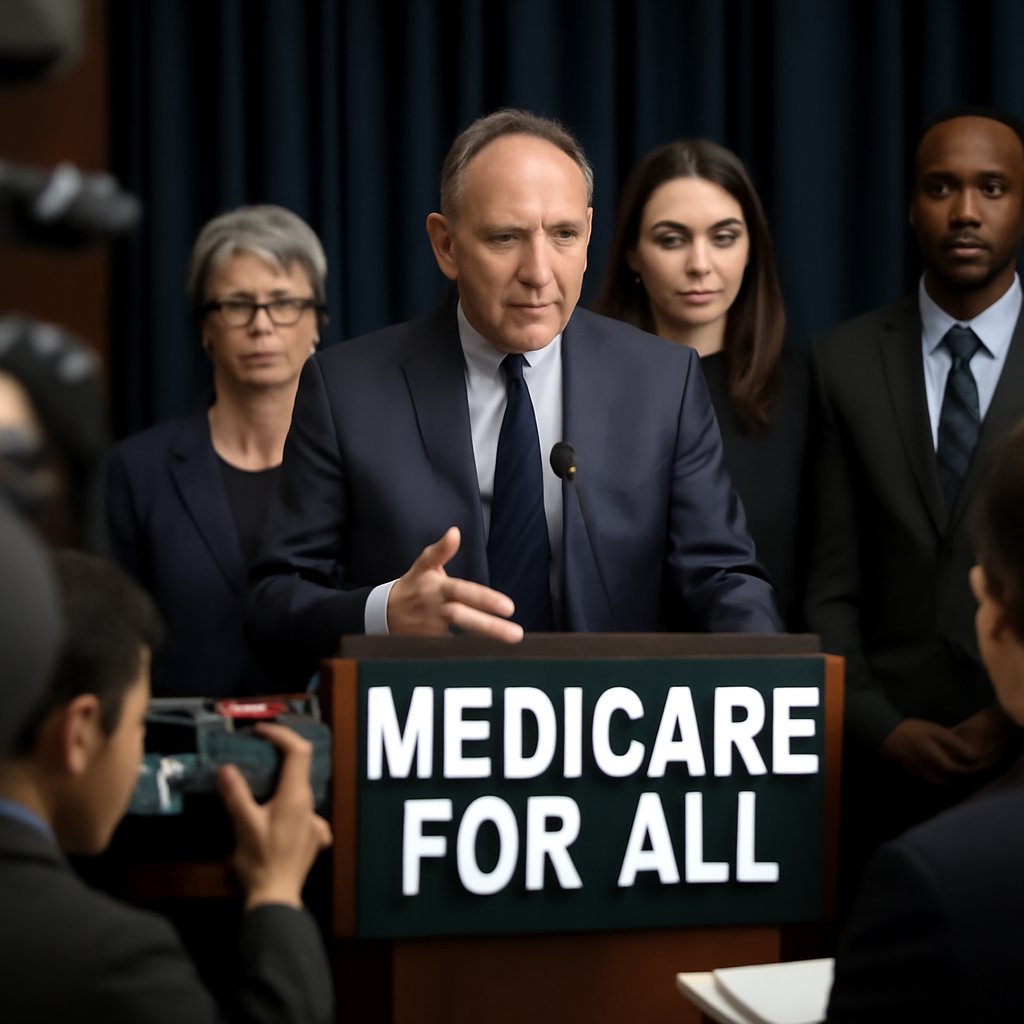
The Medicare for All debate continues to expose fault lines within the Democratic Party over how best to expand coverage while managing fiscal trade-offs and provider incentives. As someone who worked in policy analysis, the mechanism here is straightforward: a single public payer would replace the fragmented mix of employer plans, Medicaid, and Medicare with centralized rate negotiation, which in turn alters both revenue flows to hospitals and household exposure to out-of-pocket costs.
Tracing the proposal’s lineage shows it evolving from 1990s single-payer drafts through the 2016 primaries, where Senator Sanders framed it against documented premium growth and medical debt under the Affordable Care Act. Subsequent refinements drew on state-level pilots in California and New York, adjusting benefit packages to include dental, vision, and long-term care—an expansion that traditional Medicare still lacks.
Early congressional drafts laid out multi-year phase-ins that would let current Medicare beneficiaries stay put while younger cohorts transition. This staged rollout was designed to stabilize hospital finances that currently depend on higher private reimbursement rates. The data behind claims of administrative savings is actually more nuanced than reported; while traditional Medicare runs under 5 percent overhead compared with roughly 25 percent in private insurance, the transition itself would require new claims infrastructure and workforce retraining investments to absorb higher preventive-care volume.
At its core, Medicare for All would consolidate bargaining power, projecting roughly $450 billion in annual national health expenditure reductions through streamlined claims and elimination of insurer profit margins. International single-payer systems demonstrate lower per-capita spending alongside comparable or better outcomes on metrics such as amenable mortality, though critics correctly flag risks of narrower provider networks if reimbursement schedules are set too low. Patient choice of physicians would remain intact, unlike many current managed-care arrangements, while funding would shift to progressive income-based contributions rather than premiums and deductibles that often exceed several thousand dollars yearly.
Implementation timelines in recent bills emphasize minimizing disruption by retaining existing Medicare enrollment initially and layering in infrastructure grants for safety-net facilities. The political test within Democratic primaries has hardened around whether candidates endorse full single-payer or prefer a public option as an interim step, reflecting differing assessments of swing-state viability. Recent surveys place support for a Medicare for All-style system between 55 and 65 percent nationally, yet internal party modeling still shows incremental Affordable Care Act expansions polling stronger in certain battlegrounds.
Key data points remain consistent across analyses: more than 28 million Americans stay uninsured, prescription prices average nearly three times those in peer single-payer nations, and medical debt drives nearly two-thirds of personal bankruptcies. Sustained attention to these implementation mechanics and their distributional effects will determine whether any eventual legislation can deliver both universality and long-term fiscal balance.
Understanding the financing mechanisms reveals why Democratic disagreement persists even among single-payer advocates. Senator Sanders’ most recent Medicare for All bill proposed a 4 percent employee payroll tax and a 7.5 percent employer payroll tax, alongside a wealth tax on high-net-worth households and increased capital gains taxation. Preliminary estimates from the Congressional Budget Office and independent health economists at institutions like MIT and Yale suggest these revenue streams could cover the transition, but projections diverge sharply depending on assumptions about wage growth, labor supply elasticity, and whether pharmaceutical price controls might inadvertently reduce innovation incentives. Moderate Democrats counter that a public option—allowing individuals to buy into an expanded Medicare program while retaining private insurance—achieves near-universal coverage with lower political risk and avoids wholesale restructuring of a $4.5 trillion system.
The pharmaceutical pricing debate within Medicare for All discussions deserves particular attention. Current law prohibits Medicare from directly negotiating drug prices, a constraint that has allowed insulin costs to triple since 2002 despite minimal innovation. A single-payer system would grant direct negotiation authority comparable to the Veterans Health Administration, which pays roughly 40 percent less for identical medications. However, pharmaceutical manufacturers warn that price controls could reduce R&D spending on rare diseases and breakthrough therapies. International evidence from Germany, France, and Australia shows that negotiated pricing hasn’t eliminated drug development, though innovation timelines have lengthened in some therapeutic categories. The distributional question remains: should Medicare for All prioritize affordability for current patients or preserve incentives for future treatments?
Provider network concerns also warrant deeper examination. Current Medicare Advantage plans—the private insurance option within traditional Medicare—already demonstrate how restrictive networks can develop when reimbursement rates fall below fee-for-service levels. Rural hospitals particularly depend on higher-margin private insurance payments to subsidize emergency departments and trauma care that operate at losses. A single-payer system setting reimbursement nationally would face pressure to balance urban and rural provision: set rates too low and rural facilities close; set them higher and savings projections collapse. Pilot programs in Vermont and New York explored this trade-off extensively, ultimately highlighting that provider consolidation—mergers among hospital systems that increase bargaining power—might accelerate under single-payer, potentially reducing competition despite theoretical benefits of centralized negotiation.
The employer transition represents another underexplored dimension. Roughly 160 million Americans currently receive health coverage through employer plans, a system embedded in 70 years of labor contracts and union agreements. Moving to Medicare for All would eliminate employer administrative costs (estimated at $40–50 billion annually) but also displace hundreds of thousands of insurance, billing, and utilization review workers. Democratic proposals typically include wage-adjustment mechanisms and retraining subsidies, yet labor economists note that displaced workers aged 50 and above face particular challenges re-entering the workforce. Unions themselves remain divided: some see elimination of fragmented benefits as beneficial, while others worry about losing hard-won coverage supplements negotiated in lieu of wage increases.
Political economy context matters here. The insurance industry, pharmaceutical manufacturers, and hospital associations have contributed roughly $200 million annually to oppose single-payer legislation, funding “grassroots” campaigns warning of wait times and reduced access. These expenditures have proven effective in swing districts and battleground states, where undecided voters shift toward incremental approaches. Conversely, surveys show strongest single-payer support among younger Democrats and voters with recent medical debt or uninsurance experiences—constituencies vital to general-election turnout. The party’s strategic calculation hinges on whether single-payer serves as a mobilizing issue that activates base voters or becomes a vulnerability exploited through messaging about “taking away your insurance.”
International comparisons offer instructive but imperfect lessons. Canada’s system demonstrates that single-payer can achieve universal coverage with roughly 10 percent of GDP spent on healthcare versus America’s 17 percent. However, Canada faces documented physician shortages in rural areas and longer wait times for non-emergency procedures—trade-offs many Americans find unacceptable. Germany’s multi-payer system with universal mandatory coverage through heavily regulated sickness funds provides near-universal access while preserving choice, though administrative complexity approaches American levels. Taiwan’s single-payer system, implemented in 1995, achieved 99 percent population coverage within two years while maintaining provider choice, suggesting rapid transitions are feasible if political will exists.
The debate ultimately reflects deeper Democratic disagreements about market mechanisms, administrative capacity, and distributional priorities. Should healthcare be treated as a market commodity with optimized efficiency incentives, or as a public good where access shouldn’t depend on ability to pay? Can government efficiently administer a $4.5 trillion system, or are decentralized markets more responsive to patient preferences? These philosophical questions underlie technical disputes about reimbursement rates and network design. Moving forward, Democratic legislators face pressure to articulate not merely technical details but a compelling vision of what healthcare system best serves American values and circumstances—a conversation that extends far beyond Medicare for All’s mechanics into fundamental questions about social solidarity and individual responsibility.