
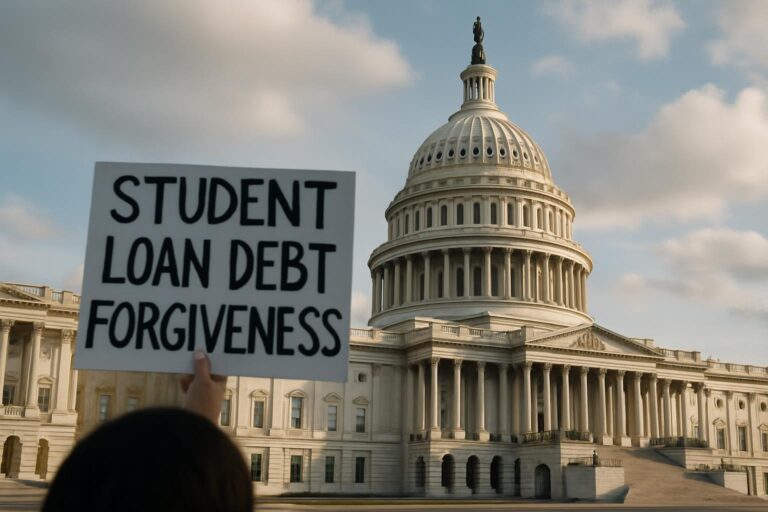
Student loan debt has become one of the more persistent structural pressures on household balance sheets in the United States, with outstanding federal balances now surpassing $1.7 trillion. As someone who worked in policy analysis, the mechanism here is straightforward but poorly understood: federal lending programs expanded rapidly after the 1990s without corresponding controls on institutional pricing, effectively turning the Department of Education into the primary financier of higher education cost growth. Roughly 43 million borrowers carry these obligations, with average balances hovering near $37,000, though the distribution is heavily skewed toward graduate and professional degree holders.
The data behind claims of uniform borrower distress is actually more nuanced than reported. Rising tuition outpaced both general inflation and median wage growth for decades, driven by declining state appropriations per student at public institutions and the ready availability of federal credit. Borrowers who attended for-profit schools show elevated default rates, while those with advanced degrees account for a disproportionate share of aggregate balances. The median monthly payment for federal student loans has increased substantially over the past two decades, now exceeding $200 for many borrowers, representing a meaningful portion of household budgets for those earning entry-level wages in their fields.
Demographic patterns reveal further complexity. Women hold the majority of outstanding debt, reflecting higher enrollment rates across degree programs. Black borrowers experience higher average balances and default rates, a disparity tied to differences in family wealth, institutional type attended, and labor-market outcomes rather than loan terms alone. Most debt is concentrated among attendees of public universities and community colleges, not elite private institutions. Research from the National Association of Student Financial Aid Administrators has documented that Black borrowers owe approximately $7,400 more on average than white borrowers four years after leaving school, a gap that widens significantly over time due to differences in repayment capacity and accrual of interest.
The historical context matters substantially here. Federal student lending dramatically shifted after the 1990s when direct lending became the predominant model. Before this transition, the government guaranteed loans made by private lenders, creating moral hazard and limiting oversight. The shift to direct federal lending should have improved accountability, yet without corresponding price controls, institutions simply raised costs further. Community colleges, which serve disproportionately low-income and first-generation students, shifted from being nearly tuition-free in many states during the 1980s to charging meaningful tuition today, a transition directly enabled by the availability of federal student loans.
Policy approaches to relief have relied on a patchwork of targeted authorities under the Higher Education Act. Programs such as Public Service Loan Forgiveness and borrower-defense discharges for students defrauded by specific schools represent narrow statutory carve-outs. Broader proposals for one-time cancellation of $10,000 or $20,000 per borrower, or expansions of income-driven repayment, have run into repeated questions of administrative authority and subsequent judicial review. The Public Service Loan Forgiveness program, established in 2007, was intended to provide loan forgiveness for borrowers who worked in qualifying public service jobs for ten years, yet administrative barriers led to a remarkably low approval rate in its first decade, with less than one percent of applicants receiving forgiveness. Only after significant advocacy and streamlined procedures did approval rates rise substantially, illustrating how well-intentioned policies can fail without proper implementation infrastructure.
Income-driven repayment plans now available through the federal government—PAYE, REPAYE, IBR, and ICR—cap monthly payments at a percentage of discretionary income and provide forgiveness after 20 to 25 years of payments. These programs have theoretically transformed the borrower experience by preventing situations where monthly payments exceed what borrowers can afford. However, the data behind implementation outcomes shows wide variation: participation in income-driven plans has grown, yet many eligible borrowers never enroll because of paperwork complexity and lack of outreach. The Department of Education estimates that millions of borrowers who would qualify for more favorable repayment terms remain unaware of these options or find the application process prohibitively complicated.
The pause on federal student loan payments instituted during the COVID-19 pandemic, initially set to expire in September 2021 but extended multiple times, provided temporary relief to borrowers while raising broader questions about long-term policy direction. During the pause, borrowers were not required to make payments and interest did not accrue on federal loans. This period allowed policymakers and advocates to reassess how the system functions and what structural changes might be beneficial. The eventual resumption of payments in late 2023, after several extensions, returned millions of borrowers to their repayment obligations and reignited debates about whether permanent relief or reform should have been implemented instead.
Advocates argue that high debt loads delay homeownership, family formation, and retirement contributions, functioning in effect as a drag on aggregate demand. Research from the Brookings Institution and others has documented correlations between student debt levels and delayed major life decisions, with borrowers carrying significant balances less likely to purchase homes or have children compared to peers with lower debt burdens. Targeted relief could deliver stimulus concentrated among lower- and middle-income households with higher marginal propensities to spend. Some analyses also link forgiveness to modest narrowing of racial wealth gaps, given documented differences in repayment trajectories. A borrower beginning their career with $30,000 in student debt faces dramatically different wealth accumulation prospects compared to one beginning debt-free, even with identical income trajectories.
Critics correctly note that broad cancellation would redistribute costs to taxpayers who never attended college or who have already repaid their loans. The fairness objection is not merely rhetorical; it involves real transfers across cohorts. Those who paid their way through college or attended community college to minimize costs would see their past sacrifices rendered less advantageous in relative terms. Concerns about short-term inflationary pressure if large balances are erased quickly are also worth weighing against evidence from past targeted programs, which showed limited macroeconomic spillovers. The Penn Wharton Budget Model estimated that broad cancellation could have inflationary effects if stimulus was concentrated in a short timeframe, though other analyses suggested effects would be modest given that borrowers would simply redirect spending rather than increase it.
Legal challenges have centered on whether executive actions exceed the scope Congress intended, a question that continues to shape program design. Multiple federal courts have blocked proposed broad cancellation programs, with decisions turning on interpretation of the Higher Education Act and Administrative Procedure Act requirements. The Supreme Court’s decision in June 2023 effectively ended the Biden administration’s proposed broad forgiveness program, finding that such large-scale action required explicit congressional authorization rather than executive discretion under existing statutes. This ruling has shifted debate toward what Congress might authorize prospectively and what narrower administrative actions remain available under existing law.
Broader economic considerations include potential effects on future borrowing behavior and institutional pricing incentives. Without accompanying reforms to accreditation standards or state funding formulas, debt levels could simply reaccumulate. Regional concentrations of debt vary significantly, with higher per-capita balances in certain states and metro areas that have large public university systems. States like Massachusetts, Connecticut, and Maryland show particularly high average balances, while states with robust community college systems and lower tuition show somewhat better outcomes, though costs have risen nationally. Any durable policy response would need to combine repayment adjustments, institutional accountability measures, and narrowly tailored cancellation rather than relying on a single lever. This might include restoring state funding for public higher education, tying federal aid to institutional outcomes, or establishing price controls on programs with poor repayment prospects relative to earnings.
Sources
- Reuters Legal – Coverage of policy and legal developments
- AP News Education Hub – Education policy and student loan news
- NPR Education – In-depth reporting on education issues
- Washington Post Education – Education policy analysis and reporting
- White House Briefing Room – Official statements on student loan policy