
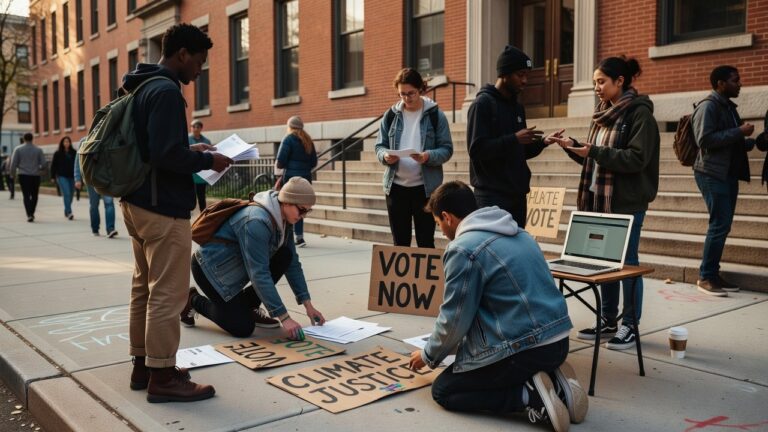

Engaging younger voters has become a structural priority for Democratic leadership on Capitol Hill, particularly as committees work to advance legislation on climate, equity, and access to care. Having covered these dynamics for a decade, the procedural emphasis on building durable coalitions with Gen Z and Millennial activists stands out because it directly feeds into sustained support for measures that must clear both chambers and withstand reconciliation procedures.
Youth-led initiatives have already altered the trajectory of several priority bills. The Sunrise Movement’s pressure campaigns and the March for Our Lives advocacy, for instance, shifted the Overton window inside the House Natural Resources and Judiciary Committees, prompting more ambitious text on emissions reductions and background-check expansions. Understanding the legislative history behind these issues goes back to the post-2018 midterm influx of younger members who brought constituent stories on student debt and voting access into markup sessions.
Effective outreach starts by mapping policy outcomes to lived experience. When Democratic committee staff frame expansions of the child tax credit or reproductive-health protections through the lens of economic security, turnout models improve in districts that flipped during the last two cycles. Local party workshops that feature young speakers testifying about their own loan burdens have mirrored the format used in Senate HELP Committee hearings, turning abstract statutory language into concrete case studies.
Digital platforms now function as an extension of traditional whip operations. Short-form content breaking down provisions of the Inflation Reduction Act or the stalled voting-rights package has measurably lifted first-time voter participation, much as targeted member-to-constituency communications once moved undecided votes in the House. Progressive caucus offices and aligned outside groups coordinate content calendars that parallel the legislative calendar, releasing explainers ahead of key floor votes rather than after.
One often overlooked dimension of youth engagement involves recognizing the diversity of generational experience itself. While Gen Z broadly shares concerns about climate and economic opportunity, lived experiences differ significantly along lines of geography, race, and socioeconomic status. Rural youth face distinct barriers to political participation compared with their urban peers—limited broadband access, fewer local Democratic infrastructure points, and different economic pressures around agricultural policy and rural healthcare. Successful outreach acknowledges these divisions rather than treating youth as a monolithic bloc. Democratic organizers working in rural counties have found success by connecting climate investments to job creation in renewable energy, rather than leading with environmental messaging alone. Similarly, framing student-debt relief through the lens of generational wealth-building resonates more powerfully in communities where first-generation college attendance is concentrated.
The role of social media in youth mobilization extends beyond simple content distribution. Platform algorithms amplify certain messages over others, and savvy Democratic digital teams now coordinate across TikTok, Instagram Reels, and YouTube Shorts with the same sophistication once reserved for television ad buys. A viral TikTok explainer on voting registration requirements can reach more young people in a single week than a year of traditional door-to-door canvassing. However, this digital-first approach carries risks. Misinformation spreads equally rapidly, and youth voters report declining trust in institutions—including Democratic Party leadership—when digital engagement feels inauthentic or algorithmically manipulated rather than genuinely grassroots.
Sustained engagement also requires the institutional infrastructure long familiar to Capitol Hill staff: mentorship pipelines and field programs. Pairing veteran organizers with new activists transmits knowledge of coalition-building and appropriations strategy that cannot be conveyed through social media alone. Voter-registration drives centered on college campuses and urban precincts replicate the ground-game architecture that produced the roughly 55 percent turnout among 18-to-29-year-olds in 2020—the highest rate for that cohort in decades and a decisive factor in several Democratic holds.
The financial dimension of youth activism deserves greater scrutiny. Young people often volunteer countless hours but lack the economic stability to sustain political engagement without compensation. Progressive organizations that have shifted toward paying organizers—even modest stipends for college students leading campus drives or neighborhood canvassers—have seen measurable improvements in retention and program quality. This reflects a broader recognition that equity commitments cannot stop at policy positions; they must extend to how movement infrastructure itself compensates labor, particularly from young people of color who have historically subsidized progressive campaigns through unpaid or underpaid work.
Barriers such as scheduling conflicts and transportation are addressed through the same accommodations used in congressional district offices: virtual participation options, childcare at events, and deliberate inclusion of voices from historically Black colleges and LGBTQ+ centers. These steps mirror the outreach protocols developed by the Congressional Black Caucus and the Congressional LGBTQ+ Equality Caucus during recent redistricting cycles. Yet moving beyond accommodation requires proactive recruitment strategies. Many young activists of color report feeling tokenized in overwhelmingly white Democratic spaces. Successful programs have moved toward building independent youth chapters within communities of color, supporting young leaders to organize their own peers rather than integrating them into existing structures designed without their input.
The relationship between electoral work and issue-based activism deserves attention as well. While some youth gravitate toward legislative pressure campaigns and direct action—protest, civil disobedience, and public testimony—others prioritize electoral organizing and candidate support. Both paths feed Democratic power, but tensions sometimes arise when climate activists perceive electoral teams as insufficiently aggressive on emissions, or when voting-rights organizers feel that campaign resources flow disproportionately toward swing states while voter suppression issues in safely Democratic areas receive less attention. Bridging these divides requires genuine dialogue and power-sharing, not directives from party leadership.
Data from the last two election cycles underscore the payoff. Youth activists drove support for state ballot measures raising minimum wages and reforming criminal-justice statutes. Surveys show roughly 70 percent of Gen Z voters rank climate action as a top concern, aligning with Democratic priorities reflected in the Green New Deal framework and subsequent committee-reported legislation. Peer-to-peer texting programs have delivered turnout lifts of 4 to 8 percent compared with older contact methods. Young women of color now constitute the fastest-growing segment of Democratic primary participants, and campus petition drives on student-debt relief have fed directly into executive-branch policy deliberations.
Looking forward, the retention of young activists beyond a single election cycle remains an open challenge. High-engagement years—presidential cycles with major ballot measures—naturally produce spikes in participation, but sustaining those numbers during midterms and local elections requires deeper investment in movement culture and long-term career pathways. States that have built robust training institutes for young organizers, offering certification in voter contact, data analysis, and fundraising, report higher retention rates and more sophisticated campaign infrastructure than those relying on transactional campaign employment.
The cumulative effect of these layered tactics—digital amplification, mentorship structures, targeted barrier removal, and genuine power-sharing with young people—reinforces the Democratic coalition’s capacity to sustain legislative momentum on equity, climate, and reproductive-rights measures well into future Congresses. Success requires viewing youth engagement not as a temporary mobilization strategy ahead of critical elections, but as foundational to the party’s institutional evolution and governing capacity.
Sources
- NPR Politics – Coverage of U.S. political news and youth engagement initiatives
- Washington Post Politics – In-depth reporting on political activism and voter participation
- AP News Politics Hub – Breaking news on political movements and civic engagement
- Reuters Politics – Global and U.S. political news and analysis