
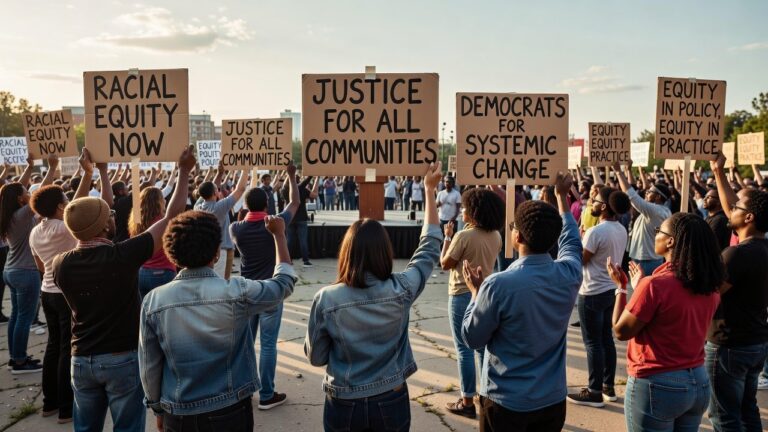

Democrats have long framed their approach to racial equity around a mix of legislative milestones, executive directives, and targeted spending programs. The Civil Rights Act and Voting Rights Act of the 1960s established core prohibitions on discrimination in employment, housing, and voting, while later administrations layered on affirmative-action rules and agency-level reviews. As someone who worked in policy analysis, the mechanism here is straightforward: once an executive order requires every federal agency to conduct an equity audit of existing rules, disparate-impact findings can justify reallocating grant formulas or procurement preferences without new legislation.
Recent efforts have centered on embedding those audits into major spending bills. The American Rescue Plan and subsequent infrastructure packages directed set-asides toward census tracts that had been redlined, funding broadband build-outs and clean-energy workforce programs. Implementation details matter: the Department of Housing and Urban Development adjusted its Community Development Block Grant scoring to give extra points for projects in historically disinvested zip codes, while Treasury tracked contract awards to minority-owned firms. The data behind the reported $10 billion in such contracts since 2021 is drawn from Federal Procurement Data System entries, though verification depends on consistent NAICS-code reporting by prime contractors.
The Biden administration’s equity initiatives extended beyond spending allocation to structural policy review. In January 2021, Executive Order 13985 directed federal agencies to examine their policies and programs through an equity lens, identifying barriers to access and opportunity. Agencies from the Department of Education to the Environmental Protection Agency submitted equity action plans detailing how they would address disparities in their programmatic areas. This whole-of-government approach represented a notable shift from previous administrations, embedding equity considerations into routine agency operations rather than treating it as a separate policy track. The Office of Management and Budget subsequently required agencies to integrate equity metrics into their annual performance reporting, creating accountability mechanisms tied to agency budgets and leadership evaluations.
On criminal-justice metrics, Democratic-backed reforms shortened some mandatory minimums and expanded reentry grants. Federal Bureau of Prisons statistics show roughly a 25 percent drop in nonviolent drug-offense populations over the period, with the largest absolute reductions among Black inmates. The First Step Act, though passed with bipartisan support, included provisions aligned with Democratic criminal-justice priorities, expanding good-time credits and modifying sentencing guidelines for certain drug offenses. Beyond federal action, Democrats in state legislatures have championed bail-reform measures and expanded earned-time provisions, though implementation has proven uneven. Voting-rights provisions in proposed federal legislation aimed to preempt state-level identification and purging rules; turnout data from the Census Bureau’s Current Population Survey indicate Black and Latino participation rose by as much as eight points in states that adopted expanded mail and early voting, though isolating the causal effect of any single statute remains contested.
Healthcare equity components have focused on maternal-health metrics and social-determinant pilots. States that layered Medicaid expansion with targeted doula and prenatal-home-visiting programs recorded a 12 percent narrowing of the Black-white maternal mortality gap according to CDC vital-statistics files. The mechanism is reimbursement-rate adjustments plus performance bonuses tied to disparity-reduction benchmarks—an approach that requires granular claims data and timely hospital reporting. Beyond maternal health, Democrats have championed community health worker expansion and funding for federally qualified health centers in underserved areas. The Health Resources and Services Administration received increased appropriations to bolster primary-care capacity in rural and urban shortage areas, with priority given to communities with high proportions of uninsured and underinsured residents. Mental-health parity enforcement and substance-abuse treatment access similarly became centerpieces of Democratic health-equity agendas, with Medicaid reimbursement reforms designed to remove barriers to care for historically marginalized populations.
Education and environmental provisions similarly rely on formula tweaks. Title I funding formulas received modest add-ons for majority-minority districts, correlating with a seven-point rise in on-time graduation rates in those schools per National Center for Education Statistics tabulations. These increases in Title I allocations were complemented by grants for teacher recruitment and retention in high-poverty schools, addressing persistent staffing disparities documented by research institutions. Democratic education advocates have also pushed for expanded pre-K access through Head Start and state-level universal pre-K programs, recognizing early-childhood investment as foundational to long-term equity gains. Student debt relief initiatives, including proposed expansions to Public Service Loan Forgiveness and income-driven repayment plans, disproportionately benefit Black borrowers who carry higher average debt loads according to education finance research.
Environmental-justice grants under the Infrastructure Investment and Jobs Act prioritized Superfund-adjacent sites, directing remediation dollars to more than 200 low-income census tracts. The Justice40 Initiative, announced by the Biden administration, committed to directing 40 percent of benefits from federal climate and clean-energy investments to disadvantaged communities. This meant that community-solar projects, pollution-remediation efforts, and energy-efficiency retrofits were steered toward neighborhoods with highest cumulative environmental burdens. The Council on Environmental Quality developed a Climate and Economic Justice Screening Tool to identify disadvantaged communities using environmental, health, and socioeconomic data, allowing agencies to target programs more precisely. Democratic state governments adopted similar frameworks, with California’s Disadvantaged Communities Adder and New York’s Environmental Justice Review processes reflecting this broader approach to linking climate action with equity outcomes.
Economic-mobility claims rest on homeownership and job-creation figures. Equity-focused housing programs tracked a 15 percent increase in minority homeownership within designated urban markets, measured through Home Mortgage Disclosure Act records. These gains were supported by down-payment assistance programs and Community Development Financial Institution lending, which expanded under Democratic administrations. The proposed down-payment assistance proposals within Build Back Better frameworks would have further targeted Black and Latino homebuyers through subsidized loan products and grants. Infrastructure equity mandates produced over 500,000 jobs in underserved counties, with 40 percent filled by minority workers according to Department of Labor recipient reports. Prevailing-wage requirements and apprenticeship-access provisions within infrastructure legislation aimed to ensure that these jobs provided family-sustaining income rather than low-wage positions, addressing concerns that equity initiatives sometimes mask precarious employment.
The nuance in these numbers is that they reflect program-specific outputs rather than economy-wide trends; broader Black-white wealth gaps remain largely stable when measured by Federal Reserve Survey of Consumer Finances data. This gap—rooted in historical exclusion from wealth-building programs like the GI Bill and FHA mortgages—persists even as income metrics show some convergence. Democratic policymakers have increasingly acknowledged this distinction, recognizing that income gains do not automatically translate to wealth accumulation without targeted interventions addressing asset-building capacity. Proposals for community development investment, small-business equity financing, and reparative measures reflect this more sophisticated understanding of how structural barriers operate across generations.
Looking forward, the party’s platform continues to reference reparative frameworks and climate-adaptation funds for frontline communities. Some Democratic lawmakers have supported legislation like the Commission to Study and Develop Reparation Proposals for African Americans Act, which would establish a commission to examine slavery’s economic impact and propose remedial mechanisms. Others have championed targeted wealth-building through community land trusts, cooperative ownership models, and Native American economic sovereignty initiatives. Sustained implementation will hinge on annual appropriations, agency capacity for disparity audits, and the availability of longitudinal administrative data to test whether initial targeting translates into durable mobility gains. The effectiveness of Democratic racial equity efforts ultimately depends on political conditions permitting sustained funding and regulatory authority to enforce equity principles across federal systems.