
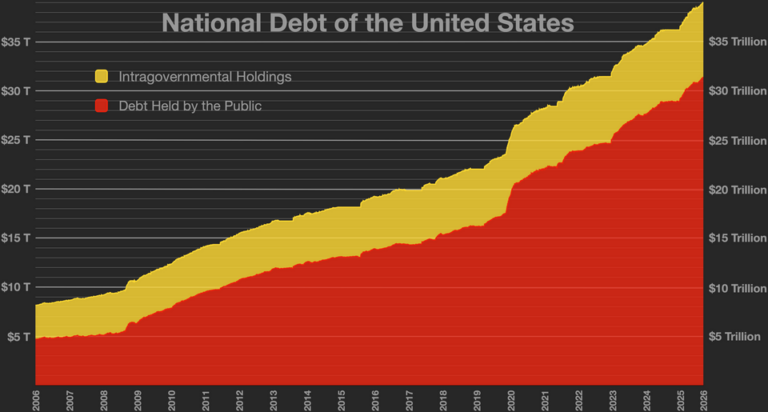

As Congress heads into another round of budget negotiations this spring, the national debt topping $34 trillion continues to shape every major fiscal debate on Capitol Hill. Having covered these fights for a decade, the procedural dance around debt-limit extensions and reconciliation instructions reveals just how little appetite either party has shown for structural reform. The trajectory since 1990 tells the story in raw numbers, with debt-to-GDP climbing from 42.2 percent under George H.W. Bush to a projected 123.5 percent by 2025.
The growth under successive administrations tracks directly to policy choices made in the House Budget Committee and on the Senate floor. Ronald Reagan oversaw an increase of $1,413 billion, or 189 percent. George H.W. Bush added $1,410 billion. Bill Clinton’s term produced a smaller $1,596 billion rise amid the surpluses that followed the 1993 budget deal. George W. Bush’s two terms saw $5,849 billion added, while Barack Obama’s eight years contributed $8,588 billion amid the aftermath of the financial crisis and the Affordable Care Act implementation. Donald Trump’s term added $6,736 billion, and Joe Biden’s first term through 2025 is on pace for $7,555 billion.
Understanding what these numbers actually mean requires unpacking the difference between annual deficits and accumulated debt. The deficit is the gap between what the federal government spends in a given fiscal year and what it collects in revenues—think of it as the annual shortfall. The national debt, by contrast, is the cumulative total of all those deficits plus interest, accumulated over centuries of federal borrowing. Every time Congress runs a deficit, that shortfall gets added to the national debt. Even if the government ran a balanced budget tomorrow, the existing $34 trillion debt would remain unless actively paid down, which hasn’t happened since the late 1990s.
Interest costs have become the most immediate constraint. Net interest payments are now projected to surpass $659 billion this year, roughly 10 percent of federal revenues, up sharply from $345 billion in 2020. That crowding-out effect directly limits what appropriators can do on discretionary accounts, a point Democratic leaders on the Senate Appropriations Committee have raised repeatedly during markups. This represents a fundamental shift in budget priorities. Two decades ago, interest consumed roughly 7 percent of revenues. At the current trajectory, interest payments could exceed defense spending within the next decade—a sobering prospect for military strategists and fiscal hawks alike.
The mechanics of how the government borrows reveal another layer of the story. The Treasury Department sells bonds, Treasury bills, and other securities to finance the debt. When investors—whether American households, pension funds, foreign governments, or central banks—buy these securities, they’re essentially lending money to the federal government in exchange for a guaranteed return. As interest rates have risen since 2022, the cost of servicing existing debt has climbed because the government must offer higher yields to attract new buyers. A one-percentage-point increase in average interest rates across the entire debt portfolio could add roughly $300 billion annually to interest costs within five years, further squeezing available funds for other priorities.
On a global basis the United States sits below Japan at 241.5 percent debt-to-GDP and Greece at 240 percent, but above Germany’s 75.4 percent and Canada’s 80.2 percent. The per-capita figure for the United States reaches $101,771, higher than any other nation listed. Roughly 64 percent of the debt remains domestically held, with foreign holders accounting for the remaining 36 percent; Japan leads foreign holdings at $1,120 billion, followed by China at $785 billion. The composition of debt holders matters because it affects both economic vulnerability and political negotiation. Heavy domestic ownership means Americans are investing in their own government’s future through retirement accounts and insurance companies, tying ordinary citizens’ financial security to fiscal stability. Foreign holdings, while often portrayed as a threat in political rhetoric, actually reflect confidence in American debt as a safe investment and provide crucial liquidity to financial markets.
The distinction between public debt and intragovernmental holdings adds important nuance often missing from popular discussions. Roughly $7 trillion of the total debt consists of money the government has borrowed from itself—essentially Social Security trust funds and other federal accounts that have accumulated surpluses and lent them to the Treasury. This intragovernmental debt doesn’t represent borrowing from outside sources but rather internal accounting between different parts of the federal government. When Social Security begins drawing down its reserves, as it’s projected to do within the next decade, that dynamic will shift significantly, potentially requiring larger amounts of external borrowing.
The drivers are familiar to anyone who has sat through Finance Committee hearings: sustained defense outlays, rising mandatory spending on Social Security and Medicare as the population ages, revenue losses from tax cuts enacted in 2001, 2003, 2017, and pandemic-era measures, plus the interest-rate shock since 2022. Mandatory spending programs—primarily Social Security, Medicare, and Medicaid—now consume roughly 50 percent of the federal budget and are growing faster than discretionary spending or revenues. Baby Boomer retirements will continue accelerating this trend, with enrollment in Social Security projected to peak around 2033 and Medicare facing persistent funding pressures. Meanwhile, revenue as a share of GDP has fallen to roughly 17-18 percent, below the historical average of 18-19 percent, creating a structural mismatch between what the government spends and what it collects.
Democrats have consistently argued that pairing spending restraint with revenue increases on high earners and corporations offers the most durable path, a position reflected in recent budget resolutions they advanced. The Biden administration and Democratic congressional leaders have pointed to their track record of deficit reduction—the deficit fell from over $3 trillion in 2020 to roughly $1.8 trillion in 2023—as evidence that a combination of revenue increases and spending discipline can bend the trajectory. Republicans, by contrast, have generally prioritized spending restraint, though military spending remains largely sacrosanct in Republican budget proposals.
The legislative history behind today’s debt levels stretches back through multiple debt-ceiling increases, continuing resolutions, and failed attempts at bipartisan fiscal commissions. The debt ceiling itself—a legislative cap on total borrowing—has become a recurring flashpoint for partisan brinkmanship, particularly since 2010. Without adjustments to either revenues or entitlement formulas, the trajectory will continue to press against every future appropriations cycle, forcing difficult tradeoffs between competing priorities and risking the kind of fiscal crisis that could trigger economic contraction.