
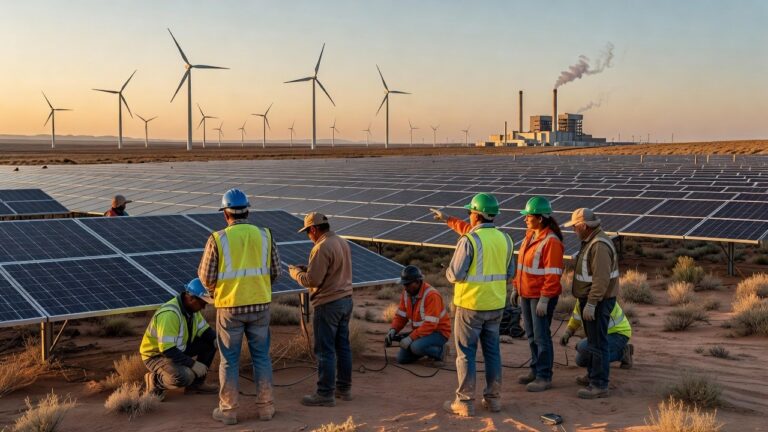
Hey, you’ve probably noticed the grid is changing faster than most folks expected. How federal incentives are reshaping America’s energy mix isn’t some abstract policy debate. It’s showing up in solar farms sprouting across Texas, wind turbines spinning off the California coast, and coal plants shutting down years ahead of schedule. The numbers tell a story that partisans on both sides sometimes prefer to ignore.
The data suggests the transformation is neither as revolutionary as progressives claim nor as insignificant as some conservatives insist. It’s somewhere between those poles. And the incentives passed by Congress in recent years are a big reason why.
What we found surprised even us.
The Scale of Federal Support
The Inflation Reduction Act poured roughly $370 billion into clean energy tax credits, loan guarantees, and manufacturing incentives. That’s real money. In practice, these aren’t just theoretical subsidies. They’re reshaping investment decisions from boardrooms in Houston to family farms in Iowa.
Consider one concrete example. In 2023, NextEra Energy, the nation’s largest renewable developer, cited federal tax credits as a decisive factor in accelerating more than 12 gigawatts of new solar and wind projects. That’s enough electricity to power roughly 9 million homes. Give or take.
These incentives don’t just lower costs. They reduce risk for developers and lenders. When the federal government effectively underwrites a portion of the downside, capital flows more freely. Banks become comfortable. Insurance companies show up. That changes everything.
How Tax Credits Tilt the Playing Field
Production Tax Credits and Investment Tax Credits have been around for decades in one form or another. But the IRA supercharged them. Suddenly, a wind project in the Midwest could claim credits worth around 2.5 cents per kilowatt-hour for the first ten years of operation. Stack that with bonus credits for using domestic steel or locating in energy communities, and the economics shift dramatically.
Here’s the contrarian point most people miss. These incentives aren’t just helping renewable energy. They’re quietly accelerating the retirement of older, less efficient natural gas and coal plants that can no longer compete on price. The market distortion works both ways. What looks like green favoritism is, in reality, a broader realignment of the entire generation stack.
The data suggests coal’s decline, already underway, sped up noticeably after 2022. Some plants that expected to run through 2035 found themselves uneconomic by 2027. Utility executives don’t always say it publicly. But off the record, many admit the math simply stopped working.
State-Level Reactions Vary Wildly
Not every state responded the same. Texas, despite its deep-red politics, has become one of the biggest beneficiaries of federal renewable incentives. The state’s competitive wholesale market allowed developers to stack federal credits with strong wind and solar resources. The result? Texas now leads the nation in wind generation and is adding solar at a blistering pace.
Contrast that with West Virginia. Federal incentives for carbon capture and hydrogen hubs have created some political cover for Senator Joe Manchin, who helped shape parts of the IRA. Yet the state’s overall energy transition remains slow and painful. Economic reality collides with cultural identity in ways policy alone can’t easily resolve.
The Manufacturing Boom That Almost Wasn’t
One of the least discussed successes involves domestic manufacturing. The IRA included incentives designed to bring solar panel, battery, and wind turbine production back to American soil. For years, the United States had watched that supply chain migrate almost entirely to Asia.
Then came the incentives. And the response was faster than most analysts predicted. By late 2023, companies had announced more than $60 billion in new clean energy manufacturing investments across 25 states. That includes everything from battery gigafactories in Georgia to solar panel plants in Ohio.
In practice, these projects still face real hurdles. Supply chain kinks, skilled labor shortages, and regulatory delays remain. But the direction of travel is clear. Federal incentives didn’t just subsidize deployment. They began rebuilding parts of the industrial base that many had written off as permanently lost.
Natural Gas, Nuclear, and the Parts We Don’t Talk About
Here’s where the conversation gets messy. While solar and wind grab most headlines, federal incentives have also supported other technologies. The Biden administration approved new loan guarantees for nuclear projects and offered tax credits for carbon capture on natural gas plants. These provisions were political necessities to pass the bill.
Yet they matter. Natural gas still provides somewhere between 35 and 40 percent of America’s electricity on any given day. Pretending otherwise doesn’t change physics or economics. The incentives recognize this reality even when the public rhetoric sometimes doesn’t.
The data suggests the energy mix is becoming more diverse rather than simply swapping one dominant fuel for another. That diversity brings both resilience and complexity. Managing a grid with thousands of small solar installations, massive battery storage systems, and fewer large spinning turbines requires new skills and new rules.
The old binary debates feel increasingly outdated.
What This Means for American Households
Energy costs remain a pocketbook issue for millions of families. Lower wholesale power prices in certain regions have helped moderate electricity bills, though inflation, supply chain issues, and transmission constraints have offset some gains. The picture varies dramatically by state and utility.
One specific example stands out. In California, despite some of the highest electricity rates in the continental U.S., federal incentives helped drive enough new solar and battery storage that the state avoided summer blackouts in 2023 that many had feared. The system proved more flexible than critics expected.
Still, not every American feels like they’re benefiting. Rural communities that once hosted coal mines or gas fields sometimes see new renewable projects as poor substitutes for the high-paying jobs and tax revenue they lost. The federal incentives include attempts at “just transition” funding. Results so far have been mixed.
The transformation continues. How federal incentives are reshaping America’s energy mix will remain a live political argument for years to come. The technology keeps improving. Costs keep falling. Political coalitions keep shifting.
The real question isn’t whether the mix is changing. It’s whether we’re building the resilient, affordable, and reliable system that a continental economy actually needs. The incentives have accelerated change. But they haven’t answered that harder question.
And maybe that’s where the next debate begins.