
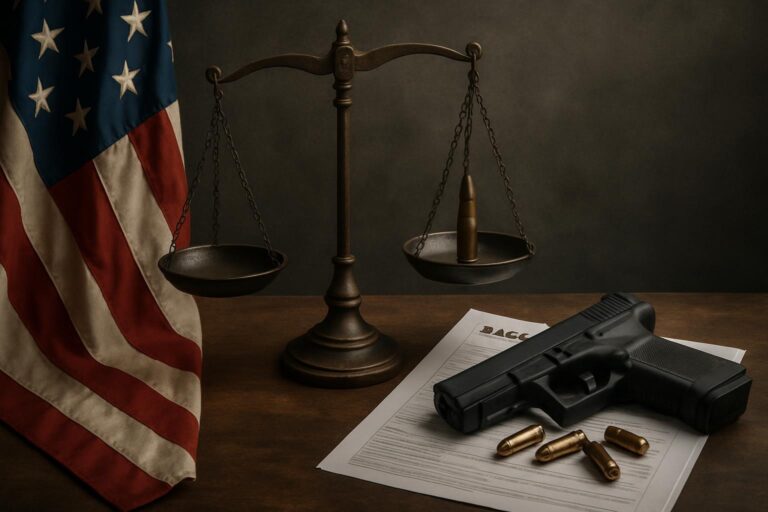
As mass shootings continue to plague American communities and gun violence remains a leading cause of death for children and teenagers, background checks have emerged as one of the most effective and broadly supported policy tools available to reduce gun deaths. Yet despite overwhelming public support—polls consistently show 80-90 percent of Americans backing universal background checks—implementation remains fragmented and enforcement inadequate. The debate over background checks sits at the intersection of public safety, constitutional rights, and political will, making it both a technical question and a litmus test for our nation’s commitment to preventing preventable tragedies.
The Current System: Gaps and Loopholes
The federal background check system, established by the Brady Act of 1993, operates through the National Instant Criminal Background Check System (NICS). Yet the system’s effectiveness is severely hampered by significant loopholes. The so-called “gun show loophole” allows private sellers to transfer firearms without conducting any background check, meaning roughly 10-15 percent of gun sales occur without screening. Additionally, many states fail to properly report criminal convictions and domestic violence incidents to NICS, leaving dangerous individuals able to purchase weapons. The Charleston loophole—which allows sales to proceed if the background check isn’t completed within three business days—has enabled numerous prohibited persons to obtain guns through administrative failures.
Research from the RAND Corporation and peer-reviewed studies consistently document that these gaps disproportionately affect public safety. Criminals and abusers intentionally circumvent licensed dealers to avoid background checks, and the decentralized nature of gun sales data makes enforcement nearly impossible. When Virginia implemented a law requiring background checks for private sales in 2020, the state saw a measurable reduction in gun homicides within two years—evidence that closing loopholes works in practice.
What the Evidence Shows
Comprehensive research demonstrates that universal background checks are associated with significant reductions in gun deaths, particularly suicides and intimate partner homicides. A landmark 2019 study in Psychiatric Services found that Connecticut’s permit-to-purchase law—which requires background checks for all handgun purchases—prevented approximately one suicide per month. Other studies have linked universal background check policies to reduced firearm suicide rates, which account for roughly 60 percent of gun deaths in America.
The evidence on homicide prevention is equally compelling. When background check systems are properly funded and states submit complete data, prohibited persons are identified and denied. Approximately two million gun purchases have been denied since NICS began operating, with roughly 58 percent denied due to felony convictions. Strengthening these systems and expanding their scope directly saves lives. Meanwhile, there is virtually no credible evidence that universal background checks violate legitimate self-defense rights or create an undue burden for responsible gun owners—the checks take minutes and cost nothing to law-abiding citizens.
The Political Stalemate
The disconnect between public opinion and legislative reality on background checks reveals the outsized influence of a well-organized minority within American politics. The gun lobby has spent decades portraying any expansion of background checks as a “slippery slope” toward confiscation, despite zero evidence supporting this claim in democracies where universal background checks exist. Countries like Canada, Australia, and most of Western Europe maintain robust background check systems alongside strong constitutional gun ownership protections, yet none have experienced the “confiscation” scenarios warned of by American opponents.
After the 2012 Newtown shooting, Senator Joe Manchin—a Democrat from gun-friendly West Virginia—attempted to broker a bipartisan compromise on universal background checks. The proposal failed despite backing from 90 percent of Americans, revealing that even modest reforms face impossible odds in a polarized Senate. The filibuster rule, which requires 60 votes to advance legislation, has effectively given a veto to Republican senators representing gun-influenced constituencies, even when those same senators’ own voters support background checks by large margins.
Moving Forward: State-Level Action and Federal Pressure
While Washington gridlock persists, progressive states have become laboratories for background check improvements. California, New York, Washington, and a growing number of other states have implemented universal background check requirements, with many also closing the Charleston loophole by extending the review period. These state-level successes provide both a policy template and political momentum for federal reform. Additionally, the Biden administration has pursued regulatory approaches, including clarifying that federal background check requirements apply to online and gun show sales—an interpretation that will likely face legal challenges but represents aggressive use of executive authority.
Advocacy groups, public health researchers, and gun violence survivors have amplified the case for background checks in ways that transcend traditional political messaging. The evidence is straightforward: universal background checks reduce gun deaths, they enjoy overwhelming public support, and they pose no genuine threat to lawful gun ownership. Moving forward requires sustained pressure on Senate Republicans to abandon obstruction in favor of evidence-based policy. The question is not whether background checks are effective—decades of research confirms they are. The question is whether America will finally align its policies with its values and its evidence.
Sources
- Reuters Politics – Latest news and analysis on U.S. political developments
- AP News Gun Violence Hub – Comprehensive coverage of firearms policy and related issues
- NPR Politics – In-depth reporting on American political news
- Washington Post Politics – Breaking news and analysis on U.S. government and elections