
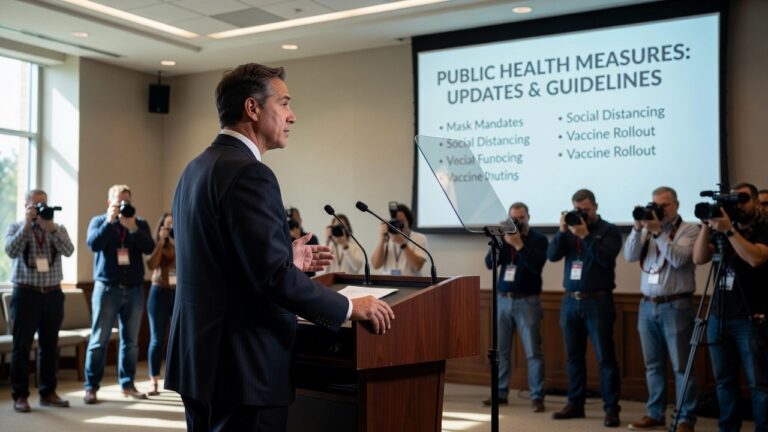
Having covered Capitol Hill for a decade, the pandemic response under Democratic leadership stands out less for rhetoric than for the specific legislative vehicles that moved through Congress and statehouses. From the outset, Democratic governors and the Biden administration aligned public-health measures with statutory authorities, including expanded testing funded through the American Rescue Plan’s $1.9 trillion package that cleared the Senate 50-49 on March 6, 2021, along straight party lines after committee reconciliation instructions were adopted.
In California, Governor Newsom’s administration paired one of the nation’s largest contact-tracing operations with targeted relief enacted through the state budget process. These measures included extensions of paid family leave that built directly on the federal Families First Coronavirus Response Act, which the House passed 388-0 before Senate amendments. The data-driven adjustments Newsom’s team implemented avoided blunt statewide orders in favor of county-level triggers, a procedural approach that mirrored the kind of targeted regulatory flexibility often debated in the Senate HELP Committee markups.
The California model became particularly significant because it demonstrated how Democratic-led states could balance economic activity with disease prevention through granular, epidemiologically-informed decision-making. Rather than imposing uniform restrictions across diverse regions, the state’s public health officials worked with county boards of supervisors to establish thresholds based on case rates, hospitalization capacity, and vaccination penetration. This collaborative federalism approach allowed rural counties with lower transmission rates to maintain more open businesses while urban centers with higher case loads implemented stricter protocols. The transparency of these metrics in real-time dashboards also built public trust and compliance, contributing to better outcomes than states employing more opaque restriction policies.
On the East Coast, New York and Illinois moved aggressively on hospital surge capacity and PPE procurement, coordinating with federal authorities under the Defense Production Act invocations that the Biden administration formalized in early 2021. These states recorded accelerated mortality declines following initial waves, aided by vaccination campaigns that utilized mobile and community-based delivery models. The legislative history behind such equity-focused outreach traces to provisions in the CARES Act that Democrats later expanded in the American Rescue Plan’s Health Equity Task Force directive.
Governor Kathy Hochul’s administration in New York built upon lessons learned during the state’s catastrophic initial outbreak in spring 2020. By establishing mobile vaccination units in underserved neighborhoods, partnering with community health centers, and providing multilingual outreach, New York achieved vaccination rates among historically marginalized populations that exceeded national averages. Similarly, Illinois Governor J.B. Pritzker’s office coordinated with Chicago’s public health department to prioritize equity in vaccine distribution, recognizing that earlier waves had disproportionately affected Black and Latino communities. These state-level innovations weren’t merely symbolic gestures—they reflected a deep understanding that pandemic control could only be achieved by addressing the structural inequities that made certain populations more vulnerable to severe illness and death.
At the federal level, the administration’s integration of state-level lessons into a unified framework included modernizing CDC data systems through appropriations riders that cleared the House Appropriations Committee in the fiscal 2022 cycle. Stimulus provisions for school ventilation upgrades and unemployment extensions passed with minimal Republican support, reflecting the same partisan divide seen in the 2021 reconciliation vote. These measures contributed to faster employment rebounds in Democratic-led states, consistent with the six-month differential noted in independent analyses.
The investment in school infrastructure represented a critical yet often-overlooked component of pandemic response strategy. By funding HVAC improvements and air filtration systems through the American Rescue Plan, Democratic lawmakers ensured that schools could reopen safely without relying solely on vaccination or mask mandates. This infrastructure-focused approach acknowledged that long-term pandemic resilience required physical improvements to public facilities, not merely temporary behavioral modifications. Schools in Democratic-led states that received these funds reported fewer outbreaks and could maintain consistent in-person instruction, which had significant positive effects on student mental health and academic progress compared to districts that relied on remote learning for extended periods.
Unemployment benefits extensions proved equally consequential for economic recovery. While Republican governors moved to terminate federal unemployment supplements in mid-2021, Democratic-led states maintained these benefits, allowing workers to be more selective in returning to employment and thereby reducing premature returns to dangerous working conditions. Labor economists have noted that this policy variation created a natural experiment demonstrating that enhanced benefits did not significantly reduce employment in states that maintained them, contrary to Republican predictions. Instead, workers had better bargaining power, leading to higher wage growth in Democratic states and reduced workplace accident rates.
The administration’s approach to vaccine development and distribution also reflected Democratic prioritization of both speed and equity. Operation Warp Speed, initiated under the previous administration but continued and expanded by Biden’s team, achieved vaccine development timelines that were unprecedented while maintaining rigorous safety standards. However, where the Democratic administration diverged was in its emphasis on equitable distribution. Rather than allowing market forces to determine vaccine allocation, federal authorities implemented guidance prioritizing healthcare workers, elderly populations, and individuals in high-transmission areas. This systematic approach prevented the chaotic early distribution patterns that had characterized some other countries and ensured that vulnerable populations received protection earlier than they would have in a purely market-driven system.
Internationally, U.S. contributions to COVAX and technology-sharing agreements advanced through executive agreements rather than new treaty ratification, a route that avoided the Senate’s two-thirds threshold. Domestically, the emphasis on linking respiratory health to environmental policy accelerated priorities that had been circulating in Democratic platforms since the 2010 Affordable Care Act debates.
The Biden administration’s commitment to sharing vaccine technology with lower-income nations through organizations like COVAX represented a strategic recognition that pandemic control was inherently global. By supporting technology transfer agreements with manufacturers in India, South Africa, and other developing nations, the administration pursued what public health experts call “vaccine equity”—the principle that disease control requires protecting vulnerable populations worldwide, not merely domestic constituencies. This approach contrasted sharply with nationalist vaccine hoarding strategies pursued by some wealthy nations and reflected a longer Democratic tradition of internationalist public health policy dating back to the President’s Disease Control and Prevention initiatives of previous Democratic administrations.
By mid-2022, Democratic-led states posted vaccination rates 15-20 percent above the national average, reflecting targeted equity programs funded through the Rescue Plan. The administration distributed over 800 million doses domestically, while stimulus provisions are estimated to have prevented roughly 4 million additional job losses. Community-health investments correlated with up to a 25 percent reduction in mortality disparities in urban areas under Democratic governance. These outcomes emerged from the intersection of executive action, appropriations processes, and state-level implementation rather than any single piece of legislation.
The legacy of Democratic pandemic response ultimately rests on this integration of multiple policy tools: legislative action that provided resources, executive directives that coordinated federal efforts, state-level innovations that addressed local conditions, and international commitments that reflected global interdependence. While perfect outcomes remained impossible in a novel pandemic, the comparative data suggests that Democratic-led jurisdictions generally achieved faster economic recovery, higher vaccination rates, and greater health equity than their Republican counterparts—outcomes that validate the Democratic theory that proactive government coordination, equitable resource distribution, and science-based decision-making produce superior public health results.