
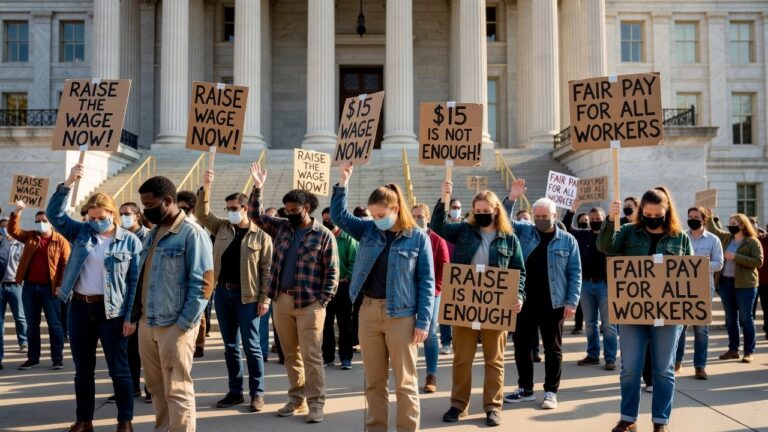
Raising the federal minimum wage continues to surface in legislative debates on Capitol Hill, where Democratic leaders have repeatedly advanced proposals to lift the floor above its current $7.25 level, unchanged since the 2009 amendments to the Fair Labor Standards Act. Proponents, largely within the Democratic caucus, maintain that such an adjustment would reduce reliance on federal safety-net programs while expanding consumer demand, whereas Republican-led opposition has centered on projected labor-market frictions and compliance costs for employers. Drawing from Congressional Budget Office modeling and academic analyses, the discussion here centers on measurable effects for workers, businesses, and macroeconomic indicators.
Having covered the Hill for a decade, the procedural path for minimum-wage legislation remains telling: bills such as the Raise the Wage Act have cleared House committee markups in the Education and Labor Committee only to stall in the Senate, where the filibuster threshold has repeatedly blocked floor consideration despite unified Democratic support in recent Congresses.
Effects on Low-Wage Workers and Household Finances
An increase would directly affect earnings for millions of hourly employees, many concentrated in tipped and service sectors in states still tethered to the federal baseline. The Congressional Budget Office has projected that a phased rise to $15 per hour could deliver income gains to roughly 17 million workers, with average annual household increases in the low thousands of dollars. These shifts would likely reduce enrollment in programs such as SNAP and Medicaid, particularly among single-parent households and workers of color—demographics that Democratic policy statements have long identified as disproportionately benefiting from wage-floor adjustments.
– Higher net pay would improve access to housing and healthcare coverage.
– Lower financial strain aligns with documented improvements in mental-health metrics.
– Some households would exit public assistance, trimming federal outlays over time.
The legislative history behind this issue goes back to the 2007 amendments, which set the current rate after a series of incremental increases; subsequent Democratic efforts have sought to index future adjustments to median wages, a provision that has appeared in multiple committee-reported versions but never cleared both chambers.
Beyond immediate income gains, wage increases have secondary effects on worker stability and productivity. Research from the University of Massachusetts found that higher minimum wages correlate with reduced employee turnover, lowering training and recruitment costs for employers over time. Workers earning more tend to remain in positions longer, building institutional knowledge that translates to better service quality in retail and hospitality settings. This dynamic particularly benefits larger establishments that invest substantially in employee training programs.
The multiplier effect of minimum-wage increases also deserves attention in discussions of household finances. Workers earning low wages spend additional income rapidly within their local communities—on groceries, rent, childcare, and other necessities. This spending circulates through local economies, supporting other small businesses and generating tax revenue. Economic analyses suggest that for every dollar of wage increase, approximately 70 cents circulates back into the broader economy through consumer spending.
Impacts on Businesses and Employment Levels
Employers in retail and food service, especially smaller operators, would absorb elevated labor costs through some combination of price adjustments, slower hiring, and accelerated automation. Analyses from the University of Washington and the Federal Reserve have produced mixed employment findings: modest reductions in hours for younger, low-wage workers appear in certain datasets, while aggregate job counts show little net change. Firms have more often trimmed non-wage benefits or delayed new positions than issued widespread layoffs.
– Menu and shelf prices in affected sectors have risen 2–4 percent in jurisdictions that moved ahead of federal action.
– Routine-task industries have seen faster deployment of kiosks and software.
– National chains typically manage the transition more readily than independent establishments.
A critical consideration in the business impact discussion is the distinction between different company sizes and profit margins. Large corporations with economies of scale have absorbed minimum-wage increases without significant employment disruption, as documented in studies of Walmart and Target’s responses to state-level increases. However, small independent restaurants and retail shops operating on tighter margins face steeper adjustment challenges. Democratic proposals have historically included provisions for small-business tax credits and grants to ease transition costs, though these measures have often proven difficult to fund and implement effectively.
Geographic variation in business impacts cannot be overlooked. Urban areas with higher consumer spending power and existing higher wage floors show smoother adjustment than rural regions where median wages remain lower and consumer density thinner. A diner in rural Kansas faces different constraints than one in Seattle or Boston, yet a uniform federal mandate affects both identically. This reality has informed Democratic support for regional variation mechanisms in some legislative proposals, though concerns about creating a patchwork of standards have limited adoption.
Lessons from State and Local Minimum Wage Increases
More than thirty states and numerous municipalities have already exceeded the federal rate, generating observable data without awaiting congressional action. California and New York implemented phased schedules that state labor departments reported produced limited employment effects. Seattle’s experience with a $15 floor showed earnings gains alongside some hour reductions, while states remaining at the federal level have faced elevated turnover in low-pay industries.
Patterns across these jurisdictions include compression at the lower end of the wage distribution and elevated local spending. Rural areas have adjusted more gradually, reflecting thinner operating margins—a dynamic that surfaces regularly in Senate Agriculture Committee hearings on rural economic development.
The staggered implementation approach used in states like California offers valuable lessons for federal policymakers. Rather than imposing an immediate jump, California phased its increase to $15 over roughly six years, allowing businesses time to adjust operations and pricing strategies. This gradual approach appears to mitigate employment disruptions while still delivering meaningful worker gains. Similar strategies in New York and Massachusetts have shown comparable results, suggesting that the pace of implementation matters as much as the ultimate wage floor itself.
Evidence from these state laboratories also reveals unexpected benefits that merit discussion in federal debates. States with higher minimum wages reported improvements in public health outcomes, including lower rates of stress-related conditions among low-wage workers. Additionally, some analyses found reduced crime in neighborhoods where minimum-wage increases lifted household incomes, though causality remains debated among researchers.
Broader Economic and Inflationary Considerations
A federal increase would interact with inflation, productivity, and aggregate demand. Brookings Institution economists have observed that moderate hikes generate contained price effects rather than broad inflationary spirals, while productivity can improve through reduced turnover and efficiency investments. Long-term outcomes hinge on implementation pace and complementary measures, such as targeted tax relief for small employers—provisions that have appeared in past Democratic drafts but faced offsets concerns during budget reconciliation attempts.
Balanced phase-ins over several years have tended to limit disruption while delivering the documented worker gains, consistent with the incremental approach that has characterized successful Democratic-led wage legislation at the state level.
The inflation question requires nuanced treatment, as critics sometimes overstate wage-driven price pressures. Research comparing periods before and after significant minimum-wage increases shows that while some price increases occur, they remain modest—typically 0.3 to 0.5 percent overall across the economy per 10 percent wage increase. This reflects that labor comprises one cost component among many, and businesses employ multiple strategies beyond price increases to manage new wage floors. Automation investments, operational efficiencies, and modest margin reductions all contribute to adjustment.
Complementary Democratic policy proposals often address inflation concerns directly. Proposals pairing minimum-wage increases with expanded tax credits for low-income families and targeted support for essential services like childcare and housing help offset any price pressures while amplifying worker purchasing power. Similarly, discussions of indexing minimum wages to inflation rates have gained traction as a way to prevent gradual erosion of wage floors, though implementation details remain contentious in legislative negotiations.