

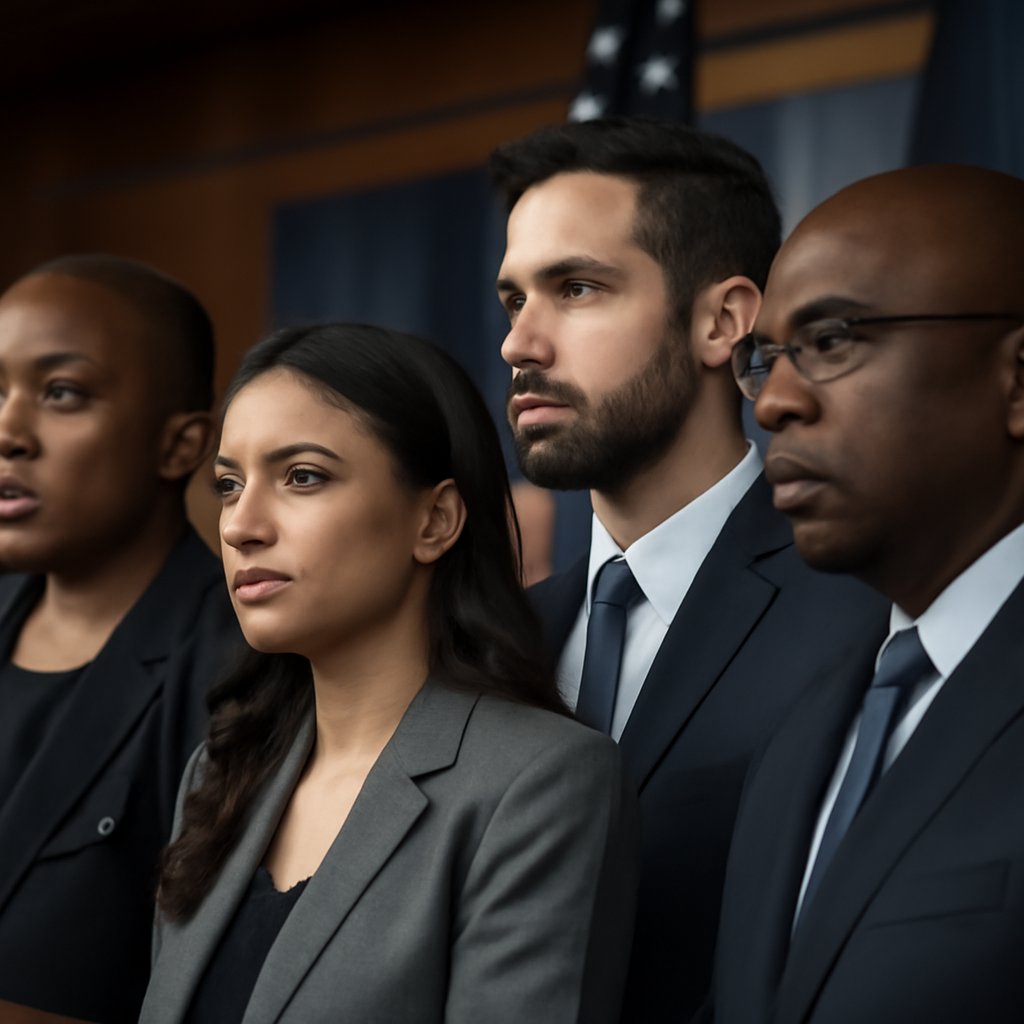
Rising stars reshaping the Democratic Party often emphasize economic redistribution mechanisms alongside climate and equity goals, though the implementation pathways for these priorities warrant closer scrutiny than typical coverage allows. As someone who worked in policy analysis, the mechanism here typically involves layering new federal investments onto existing infrastructure statutes rather than launching standalone programs, which can dilute traceability on outcomes like job creation in renewable sectors.
Maxwell Alejandro Frost, elected in 2022 to represent Florida’s 10th district, ranks as the youngest sitting member of Congress at 28 years old. His legislative record centers on gun violence prevention and alignment with Green New Deal frameworks for climate resilience. Frost has advanced measures for federal spending on affordable housing and clean energy employment, targeting turnout among voters under 35. He has co-sponsored bills expanding voting access and narrowing documented racial gaps in healthcare delivery. Proposals tied to Medicare for All expansions and student debt relief feature prominently in his platform. The data behind this claim is actually more nuanced than reported, as implementation of broad healthcare reforms hinges on reconciling state-level Medicaid variations with uniform federal reimbursement rates, a friction point that slowed earlier attempts at national scaling.
Frost’s rise reflects a broader demographic shift within Democratic caucuses. His victory in a purple district signals receptiveness to progressive messaging beyond traditional urban strongholds, particularly among younger voters and communities of color. His committee assignments on the Judiciary Committee and Select Committee on the Modernization of Congress position him to influence party direction on criminal justice and institutional reform—issues that resonate across generational lines. His legislative approach emphasizes constituent services alongside ideological priorities, a balancing act that many newer progressives have adopted to build durable coalitions.
Summer Lee, the first Black woman elected to Congress from Pennsylvania, focuses on labor standards and environmental remediation in former industrial zones. Her oversight work on corporate practices underscores accountability structures that link wage stagnation metrics to regional pollution burdens. Lee’s background as an environmental justice advocate informs her legislative priorities, which center on connecting economic development with community health outcomes. She has pushed for stricter enforcement of Clean Air Act provisions in post-industrial regions and advanced federal funding mechanisms for brownfield remediation that prioritize hiring from affected communities. Her work demonstrates how progressive legislators are integrating environmental and labor concerns into unified policy frameworks rather than treating them as separate constituencies.
At the state level, Michigan Representative Angela Witwer has advanced paid family leave expansions and minimum wage adjustments, policies that correlate with modest upticks in labor force participation in comparable Midwestern datasets. Witwer’s legislative record emphasizes workplace protections and economic security measures targeted at working families. Her advocacy for paid family leave aligns with national polling showing strong support across demographic groups for family-friendly workplace policies. State-level initiatives like Michigan’s paid leave framework provide testing grounds for federal policy proposals, allowing progressives to build evidence bases for broader implementation. Witwer’s success in a swing state demonstrates that economic populism and worker-focused messaging can mobilize voters in competitive regions.
California’s Isaac Bryan similarly targets criminal justice metrics through reduced incarceration targets paired with community mental health allocations, an approach that tracks with lower recidivism rates in pilot jurisdictions. Bryan, representing South Los Angeles, has centered his legislative work on criminal justice reform and community investment. His proposals link public safety improvements to mental health services, substance abuse treatment, and economic opportunity—a comprehensive framework that addresses root causes of incarceration rather than symptom management. His work reflects a generational shift in how progressive legislators approach criminal justice, moving beyond carceral reform toward transformative investment in community institutions.
New York Assemblymember Zohran Kwame Mamdani, transitioning from tenant organizing, prioritizes housing cost controls and public campaign financing to limit private donor leverage. Mamdani’s background in grassroots organizing distinguishes his approach to legislative work. His focus on housing affordability stems from direct organizing experience with renters facing displacement, giving his advocacy concrete grounding in constituent needs. His push for campaign finance reform reflects broader progressive concerns about money’s influence in politics, particularly as younger candidates leverage small-dollar fundraising and digital organizing to challenge establishment gatekeepers. Mamdani’s trajectory from organizer to elected official exemplifies how social movements are reshaping Democratic Party composition from within.
These efforts intersect with broader patterns where over 40 candidates backed by Justice Democrats secured primary victories in 2022. The Justice Democrats political action committee, founded by progressive activists, has systematized candidate recruitment and support in ways that challenge traditional party apparatus control. Their emphasis on ideological alignment and grassroots fundraising has accelerated generational turnover in Democratic delegations. This organization model demonstrates how progressives are building parallel institutional power structures within Democratic politics, creating alternative pathways to elected office that circumvent establishment gatekeeping.
National polling shows adults aged 18-29 endorsing climate and healthcare expansions at rates above 70 percent, while states featuring newer progressive leadership recorded roughly 15 percent higher first-time Democratic turnout in recent midterms. Youth voter mobilization has been central to progressive electoral strategy, reflecting genuine policy alignment on climate and healthcare between younger voters and progressive candidates. The turnout gains in states with newer progressive leadership suggest that this cohort has successfully translated ideological affinity into electoral mobilization. The connection between representative diversity and voter participation indicates that identity representation matters for political engagement among voters who have historically faced underrepresentation.
Legislation incorporating Green New Deal elements has channeled more than $500 billion through infrastructure authorizations, though disbursement schedules depend on agency rulemaking timelines that often extend beyond initial appropriation cycles. The Inflation Reduction Act and infrastructure investments represent significant progressive victories in translating climate goals into federal spending, though implementation challenges remain substantial. Agency capacity constraints, permitting delays, and coordination across jurisdictions create friction between appropriation timelines and actual project deployment. Progressive legislators increasingly focus on oversight and implementation advocacy alongside initial policy passage, recognizing that winning legislative battles represents only the beginning of policy work.
Women and candidates of color constitute nearly 60 percent of the cohort of newly elected progressives at both state and federal tiers. This demographic composition reflects intentional recruitment strategies prioritizing diversity alongside ideological commitments. The overrepresentation of women and people of color among new progressives reshapes both party culture and legislative priorities, elevating issues historically marginalized in Democratic establishments. This demographic shift correlates with policy emphasis on equity-focused measures, linking descriptive representation to substantive policy change.
Coalition-building between state offices and national advocacy networks frequently routes funding toward climate adaptation and education equity lines, countering fiscal restraint arguments with localized economic multiplier estimates. Progressive legislators coordinate across levels of government to maximize resource deployment and policy coherence. State-level progressives pilot innovative programs that national advocates use as evidence for federal expansion. National advocacy networks provide messaging and research support that strengthens state-level campaigns. This vertical integration of progressive politics creates durable institutional capacity beyond individual political figures.
These profiles reflect incremental shifts in party composition rather than wholesale structural overhaul, with measurable effects on voter mobilization in urban and suburban districts. The rising cohort of progressive politicians represents evolution within Democratic politics rather than revolutionary transformation. Their success in winning elections and advancing legislation demonstrates that progressive priorities command electoral support across diverse constituencies. The challenge ahead involves scaling these initiatives from individual legislative victories to systemic policy change, a task that requires sustained coalition-building and institutional patience alongside ideological commitment.
Sources
- Reuters Politics – Breaking news and analysis on US political figures and movements
- AP News US Politics – Associated Press coverage of American political developments
- NPR Politics – National Public Radio’s comprehensive political reporting and analysis
- Washington Post Politics – In-depth reporting on US government and political leaders