
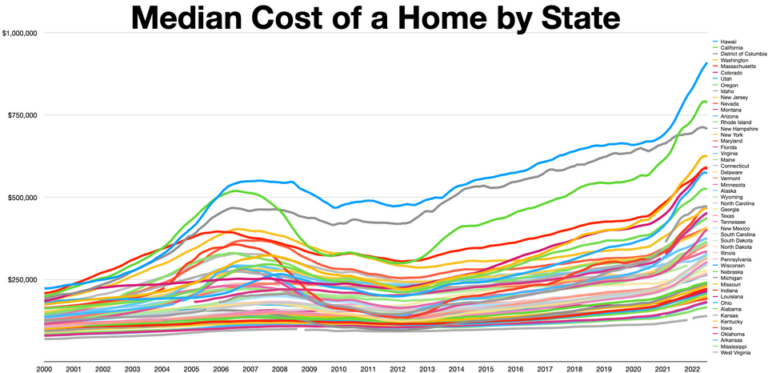
The US housing market continues to reflect the lingering effects of pandemic-era stimulus policies, shifting demographics, and uneven regulatory frameworks at the state and local levels. After rapid price escalation through 2022, data now point to a period of stabilization marked by cooling in some high-cost metros and persistent supply constraints elsewhere. As someone who worked in policy analysis, the mechanism here is straightforward: mortgage rate volatility, driven by Federal Reserve tightening from 2022 onward, interacted with zoning rules and permitting delays to produce the current split between buyer- and seller-favorable regions.
Median prices remain highest in coastal tech and finance centers. San Jose-Sunnyvale-Santa Clara posted a 2025 median of $1.45 million, down 2.3 percent year-over-year, while San Francisco-Oakland-Berkeley reached $1.225 million with a 1.8 percent decline. Los Angeles-Long Beach-Anaheim held at $875,500, up slightly by 0.5 percent. New York-Newark-Jersey City listed $625,000 after a 2.1 percent rise, and Boston-Cambridge-Newton stood at $612,500 with 1.2 percent growth. The data behind these figures are actually more nuanced than reported, because they embed both pandemic demand surges and recent modest corrections tied to higher borrowing costs.
Mortgage rates tell a clearer policy story. Quarterly averages moved from 3.07 percent annually in 2020 to a peak of 6.78 percent in 2023 before easing to 5.18 percent in the first quarter of 2025. The trajectory shows how aggressive federal funds rate hikes compressed affordability, then partial reversal in late 2024 offered limited relief. The National Association of Realtors Housing Affordability Index illustrates the cumulative impact: it fell from 146.3 in 2020 to 89.7 by mid-2024 before a modest rebound to roughly 92.4, reflecting the gap between 47 percent home-price growth and only 18 percent median-income growth over the same span.
The affordability crisis has reshaped buyer demographics in ways that deserve closer scrutiny. Younger households face a significantly steeper climb than their parents did at similar life stages. The median down payment for first-time buyers has climbed to approximately 7 percent of home prices, still below the historical 10 to 20 percent norm, but coupled with higher mortgage rates, monthly payments have surged 50 percent since 2020 for comparable properties. This squeeze has disproportionately affected Black and Latino households, who faced stricter lending standards even before the rate environment tightened, perpetuating wealth gaps rooted in decades of discriminatory housing policy. Federal interventions like down payment assistance programs have expanded, but funding remains inadequate relative to demand, and eligibility thresholds often exclude workers in high-cost regions where median incomes appear deceptively high.
New construction data underscore implementation shortfalls. Single-family starts are projected at 810,000 units for 2025, a 4.2 percent drop from 2024, while multifamily units reach an estimated 480,000. Roughly 58 percent of this activity concentrates in Texas, Florida, Arizona, Georgia, North Carolina, and Tennessee, where lighter zoning and lower land costs reduce barriers. In contrast, coastal and northeastern states continue to face regulatory delays that limit supply response. This geographic concentration reflects not just market preference but also policy choices that have compounded regional inequality. States with permissive zoning have attracted migration and investment, creating feedback loops of growth and opportunity, while restrictive states have seen stagnation in housing supply even as demand persists.
The role of institutional investors and corporate landlords has grown substantially, reshaping the nature of homeownership itself. Private equity firms and real estate investment trusts now own roughly 2.5 million single-family homes, up from fewer than 1 million in 2012. In some neighborhoods, institutional investors account for 15 to 20 percent of purchases, bidding up prices and converting owner-occupied homes into rental properties. This shift reduces opportunities for wealth-building through homeownership—historically the primary mechanism for intergenerational wealth transfer among working and middle-class families—while increasing rental costs as institutional owners pursue higher returns. Policy responses at the state level, including restrictions on corporate home purchases and incentives for community land trusts, have emerged unevenly, creating patchworks that reflect local political will rather than coordinated national strategy.
Regional conditions diverge sharply. The Northeast mixes seller markets in New York City with buyer markets in Buffalo and Rochester, reflecting slower job growth and stricter local land-use rules. The Southeast, especially Atlanta and Charlotte, sustains seller leverage from migration inflows and business-friendly policies, though Memphis and Nashville show early inventory increases. Midwest metros such as Chicago and Minneapolis exhibit buyer-market traits with steadier inventory and modest price gains. Texas and Arizona vary by metro, with Austin retaining seller pressure from tech expansion while Phoenix moves toward balance. West Coast markets, particularly San Francisco and Seattle, have seen inventory rise enough to shift bargaining power toward buyers.
Rental markets are experiencing equally significant pressures that often receive less media attention than sales prices. Median rents nationally have climbed 30 percent since 2020, with coastal metros and Sun Belt boom towns leading increases. Renters now spend approximately 31 percent of income on housing costs on average, surpassing the 30 percent affordability threshold that housing researchers consider sustainable. The connection between owner-occupied supply constraints and rental demand is direct: when zoning prevents new apartment construction and single-family home prices remain elevated, prospective buyers remain renters longer, tightening vacancy rates and pushing up rents. Some progressive cities have experimented with rent stabilization measures, but these often face legal challenges and can inadvertently reduce new construction incentives, creating new supply bottlenecks.
These patterns highlight how federal monetary policy, state tax regimes, and municipal permitting processes combine to shape outcomes. First-time buyers now account for 26 percent of purchases, down from 32 percent in 2020, underscoring the affordability squeeze that has redirected demand into rental markets. Policymakers seeking to expand supply would need coordinated changes to zoning, permitting timelines, and builder incentives, none of which have scaled nationally despite repeated proposals. The Biden administration’s National Housing Shortage Plan proposed streamlined permitting and incentives for zoning reform, but implementation faced state and local resistance rooted partly in NIMBYism—neighborhood opposition to density increases—and partly in legitimate concerns about displacement and gentrification in communities with existing affordability problems.
Looking forward, the housing market outlook hinges on Federal Reserve policy, wage growth, and regulatory reform. If mortgage rates stabilize in the 5 to 6 percent range and wage growth accelerates above inflation, some affordability recovery is possible. Conversely, a return to 7 percent rates would further compress demand and likely trigger price corrections in overheated markets. The regulatory path is less predictable: sustained political pressure for zoning reform may gradually shift local practice, but meaningful change requires overcoming entrenched interests and addressing legitimate concerns about equitable development. The housing challenge is ultimately inseparable from broader questions of economic inequality, regional development, and the role of government in shaping opportunity.