

Supporting progressive candidates at the municipal and state legislative levels remains one of the most direct avenues for advancing core Democratic priorities, from addressing structural inequality to advancing climate resilience measures and expanding access to social services. Having covered Capitol Hill for a decade, the procedural reality is that talent pipelines for committee leadership and floor votes on major legislation are built from the ground up in these lower-profile contests, where early wins on issues like minimum-wage indexing or housing density reforms can shape state party platforms for years.
Local election outcomes influence everything from K-12 funding formulas to state environmental permitting rules, creating the foundation that later informs congressional markups and conference negotiations. When Democratic candidates secure these seats, they establish voting records that become reference points in future primary challenges and general-election debates, while simultaneously blunting Republican efforts to lock in restrictive policies at the state level before they reach federal dockets.
To identify aligned candidates, activists typically begin with county Democratic committees, organizations such as Indivisible or Our Revolution, and nonpartisan voter guides issued by groups like the League of Women Voters. The legislative history behind many of these races traces back to the post-2010 redistricting cycle, when progressives learned that sustained attention to school-board and city-council contests could prevent conservative majorities from advancing measures that later complicate federal appropriations riders. Platforms emphasizing racial equity metrics, collective-bargaining protections, and greenhouse-gas reduction targets are the clearest signals; cross-referencing a candidate’s prior support for wage-floor increases or Medicaid expansion offers a reliable proxy for how they will vote once in office.
Beyond committee endorsements, prospective supporters should examine a candidate’s voting history on specific policy issues. Many county assessor websites and local news archives contain records of prior council votes or public statements that reveal substantive commitments rather than campaign rhetoric. Progressive Data for Action and Vote411.org provide searchable databases of candidate positions on issues ranging from criminal-justice reform to zoning policy. When evaluating candidates in state legislative primaries, prioritize those who have demonstrated ability to build coalitions across demographic lines—candidates who can articulate how progressive policies address the concrete concerns of working families, seniors, and communities of color tend to perform better in general elections and prove more effective legislators once elected.
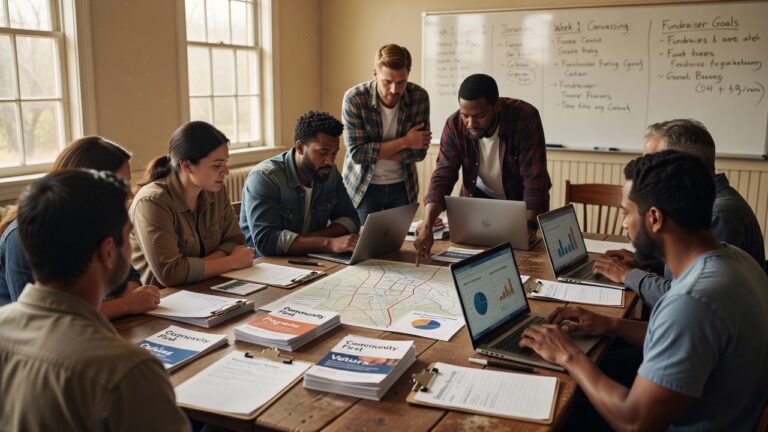
Grassroots mobilization—phone banking, block canvassing, and peer-to-peer texting—continues to drive the turnout differentials that decide close local races. These tactics build the relational infrastructure that later translates into reliable constituent contact lists for members once they reach state legislatures or Congress. Hosting candidate forums and joint registration drives with labor councils, environmental coalitions, and civil-rights organizations has repeatedly produced the cross-constituency margins needed to flip suburban and exurban districts, as documented in multiple cycles since 2018.
The mechanics of effective local canvassing deserve particular attention. Research by the University of Michigan and the Harvard Kennedy School demonstrates that door-to-door conversations, when paired with structured voter contact scripts, increase turnout by 3-7 percentage points in local races. Training volunteer canvassers to listen and respond to voter concerns—rather than simply delivering standardized messaging—builds trust and elevates participation. Weekend door-knocking campaigns in the six weeks preceding election day prove especially effective, particularly in neighborhoods with historical undervoting in off-cycle municipal elections. Coordinating with allied labor organizations and faith-based groups amplifies reach and lends institutional credibility, particularly in working-class precincts.
Small-dollar contributions through platforms like ActBlue remain disproportionately effective in down-ballot contests where paid media budgets are modest. Supplementing those donations with op-eds in local papers and coordinated social-media amplification keeps issues such as reproductive-health access and firearm-safety statutes in the local news cycle, pressuring incumbents and raising the salience of Democratic positions ahead of committee hearings on related state legislation.
Digital organizing has become increasingly essential in local campaigns. Activists can leverage Facebook’s targeting tools to identify persuadable voters in specific neighborhoods, while email lists cultivated through candidate websites and text-message programs enable rapid response to breaking news or opponent attacks. Some of the most successful 2022 and 2024 municipal campaigns integrated these digital tools with hyperlocal organizing—creating themed “pizza and politics” events in neighborhoods, organizing issue-specific community conversations on housing or public safety, and utilizing WhatsApp and Signal for rapid peer-to-peer organizing among trusted networks. This approach acknowledges that many voters, particularly in municipal races with limited media coverage, rely on personal networks and trusted community institutions for political information.
Key data points underscore the leverage of these efforts. Local contests routinely post turnout rates 20-30 percent below presidential or midterm levels, so targeted mobilization yields outsized returns. Communities with robust Democratic field operations have shown accelerated adoption of policies such as paid family leave, according to tracking by the Center for American Progress. More than 70 percent of state legislative districts are decided by fewer than 5,000 votes, while progressive-backed ballot measures on wage and healthcare expansion have cleared thresholds in over 15 states since 2018. Youth participation in municipal races has increased by 12 percent in jurisdictions with dedicated Democratic outreach programs.
The relationship between local organizing and state-level victories cannot be overstated. Successful municipal campaigns in cities like Minneapolis, Austin, and Portland established grassroots infrastructure that later proved decisive in state legislative primaries. Volunteers trained in local campaigns become the digital organizers, field directors, and campaign managers for higher offices. This pipeline effect means that investing time and resources in a school-board race or city-council primary not only determines local policy outcomes but simultaneously strengthens the organizational capacity available to progressive candidates running for state office two or four years hence.
Specific tactics for supporting candidates beyond fundraising and volunteering include: organizing community candidate forums where local voters can directly question candidates on schools, housing, or public safety; circulating candidate endorsement petitions within faith communities, unions, and neighborhood associations; writing letters to the editor highlighting candidate accomplishments or contrasting their positions with opponents; creating shareable social-media graphics that translate candidate policy positions into accessible language; and mobilizing voters on early-voting and election days through coordinated reminder texts and phone calls. Some organizations have successfully used digital tools to crowdsource voter contact lists from supporters’ personal networks, dramatically expanding reach without requiring large paid staff.
Progressive candidates at the local level face particular financial disadvantages against well-funded incumbents or opponents backed by real-estate interests and conservative donors. This reality makes grassroots support—volunteer hours, small donations, and authentic peer-to-peer persuasion—genuinely determinative. A single dedicated volunteer who knocks on 100 doors over a campaign cycle can influence dozens of voter decisions. When multiplied across dozens or hundreds of volunteers in a municipal race, this activity reshapes electoral outcomes far more reliably than expensive television buys that often don’t reach persuadable voters in low-turnout local elections.
Taken together, these activities construct durable organizational capacity that feeds upward into higher office, strengthening the Democratic bench and producing measurable policy gains at every level of government.
Sources
- Reuters Politics – Latest political news and analysis
- AP News Elections – Coverage of campaigns and voting
- NPR Politics – In-depth political reporting and interviews
- Washington Post Politics – National political news and investigations
- Washington Post Opinions – Analysis and commentary on political issues