

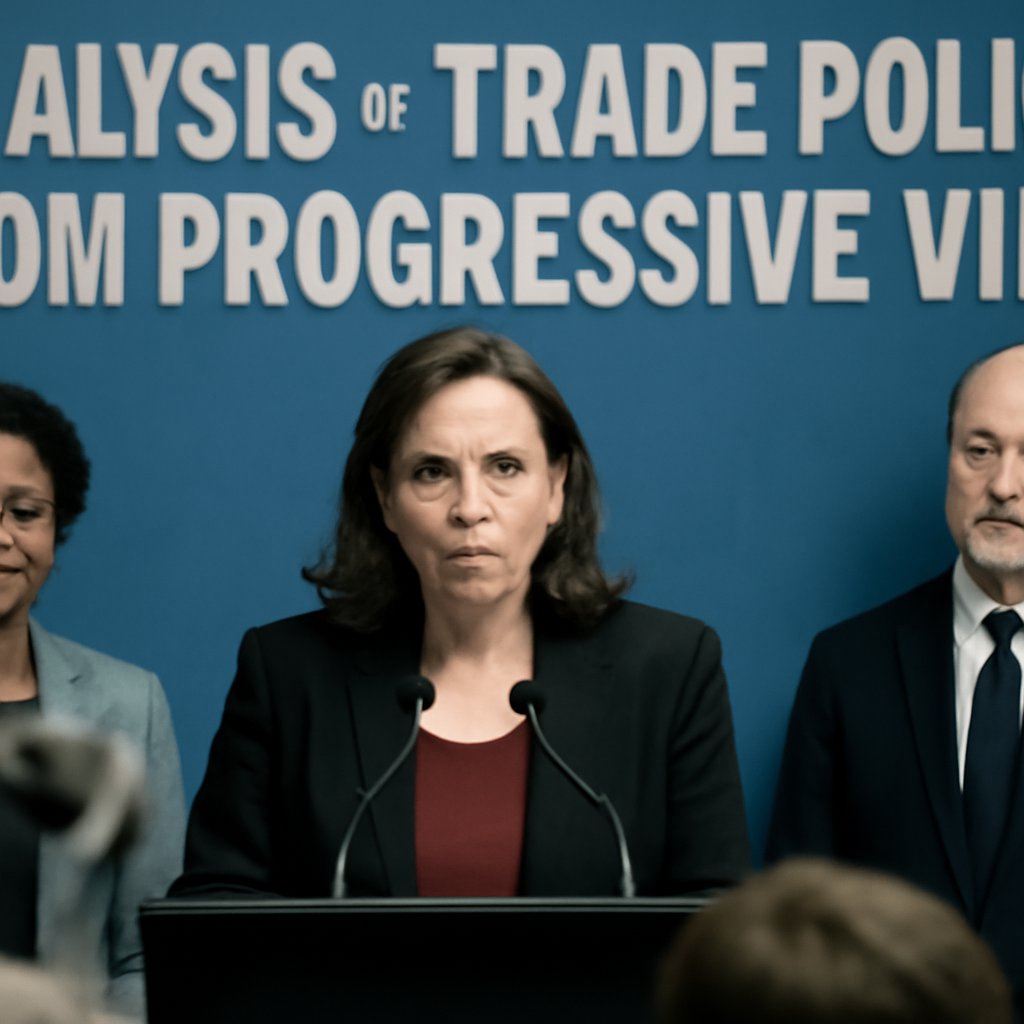
When examining trade policies through a progressive lens, the emphasis falls squarely on redirecting international commerce toward enforceable equity measures, worker safeguards, and environmental benchmarks instead of the prior emphasis on unfettered corporate expansion. Democratic policymakers have consistently highlighted how legacy agreements funneled gains primarily to multinationals while exposing U.S. communities to downward pressure on labor standards and climate objectives. This framework favors binding “fair trade” provisions over pure free-trade models, incorporating labor rights, emissions controls, and redistribution tools to offset decades of uneven outcomes.
As someone who worked in policy analysis, the mechanism here is straightforward: without strong enforcement clauses, prior pacts allowed production shifts to lower-cost jurisdictions with limited oversight, a pattern visible in the post-NAFTA period. The data behind NAFTA-related job displacement claims is actually more nuanced than reported; Economic Policy Institute modeling attributes roughly 850,000 manufacturing positions lost between 1994 and 2010, concentrated in union-heavy sectors, though broader automation and domestic demand shifts also played roles.
The move from NAFTA to the United States-Mexico-Canada Agreement illustrates targeted implementation adjustments. Democrats secured updated labor chapters requiring Mexico to strengthen union formation rules and raise border-region wages, alongside environmental provisions addressing illegal logging and marine pollution. In practice, Mexico has enacted minimum-wage increases exceeding 20 percent in key export zones since 2019, though sustained verification remains essential for lasting effect.
Central to progressive trade design is acknowledgment that globalization has widened income dispersion. Top earners captured nearly 60 percent of gains from 1980 to 2016 while median wages stagnated in many import-competing regions, producing persistent unemployment and fiscal strain on local services. Policy responses now embed adjustment assistance, domestic-content rules, and strategic outlays in sectors such as semiconductors and clean energy—recent legislation directing over $50 billion toward reshoring efforts that aim to generate higher-wage positions.
Modern proposals further require trading partners to meet core International Labor Organization standards on association and bargaining, countering deregulation-focused alternatives. Implementation details matter: these clauses operate through dispute mechanisms rather than voluntary pledges, aiming to lift baseline conditions abroad while insulating domestic workers.
On the environmental side, progressive analysis incorporates tools like carbon border adjustments to internalize emissions costs embedded in imports. Modeling from liberal research groups projects potential annual global reductions up to 4 percent if major economies align such measures, complementing commitments under frameworks like the Paris Agreement. Equity considerations extend to technology transfers and preferential market access for sustainably produced goods from developing nations, intended to ease migration drivers and diversify supply chains away from concentrated geopolitical risks.
The data behind inequality and emissions claims requires careful parsing—globalization’s effects interact with tax policy, education access, and domestic investment patterns—but the directional trends in manufacturing exposure and carbon leakage remain well-documented.
Progressive trade advocates emphasize that the challenge extends beyond bilateral negotiations. Supply chain resilience emerged as a critical issue following pandemic-related disruptions and semiconductor shortages that exposed dependence on unstable sourcing. The Biden administration’s “Friend-shoring” approach reflects this thinking—prioritizing trade relationships with democratic allies and countries meeting labor and environmental standards, rather than purely pursuing lowest-cost suppliers. This strategy acknowledges that economic security and national security increasingly overlap, particularly in critical sectors like medical equipment, battery production, and advanced manufacturing.
The progressive framework also incorporates robust Trade Adjustment Assistance (TAA) programs, recognizing that some job displacement remains inevitable despite policy safeguards. These programs fund worker retraining, income support, and community development in affected regions. However, critics from within progressive circles note that TAA funding has historically been insufficient relative to displacement scale, and coverage gaps persist for service-sector workers and gig economy participants. Expanding these programs to cover a broader worker base and provide more comprehensive support represents an ongoing policy debate among Democratic economists.
Investment in workforce development paired with trade policy creates the foundation for sustainable economic transitions. Community colleges, apprenticeship programs, and union training initiatives can position displaced workers for emerging opportunities in renewable energy, infrastructure, and advanced manufacturing. Democrats increasingly frame trade policy not in isolation but as part of a broader industrial policy framework aimed at rebuilding domestic capacity while meeting climate commitments.
The intellectual property and digital trade dimensions also warrant progressive scrutiny. Traditional trade agreements often expanded patent protections and corporate intellectual property rights, which progressives argue can limit medication access, agricultural innovation in developing nations, and digital competition. Newer Democratic-aligned proposals seek to balance innovation incentives with broader public health and development goals, particularly regarding pharmaceutical pricing and licensing for essential medicines.
China’s role in global trade presents particular complexity for progressive analysis. While critical of unfair Chinese trading practices and intellectual property theft, progressives generally oppose the tariff-heavy approach favored by the Trump administration, viewing it as economically inefficient and regressive. Instead, the progressive preference emphasizes coordinated multilateral pressure through alliances, supporting enforcement mechanisms that target specific violations rather than broad sectoral tariffs that increase consumer costs disproportionately for lower-income households.
Regional trade partnerships, particularly strengthening ties with Central America and the Caribbean, feature prominently in progressive trade strategy. These relationships offer opportunities to address root causes of migration pressure through sustainable development financing, labor standards enforcement, and environmental protection—all embedded within trade frameworks rather than treated as separate foreign aid concerns. Enhanced market access for responsibly produced goods from these regions can create economic alternatives to informal economy participation and drug trafficking.
Agricultural trade presents another nuanced progressive concern. While supporting farmers, progressives push for standards preventing dumping of subsidized American crops into developing markets, which undercuts local agricultural sectors and rural livelihoods abroad. Fair trade principles applied to agricultural products—ensuring farmer compensation, environmental stewardship, and crop diversity—align with both equity and climate objectives.
The role of international labor enforcement mechanisms deserves emphasis. Unlike earlier agreements where labor provisions operated as side agreements with limited teeth, modern Democratic proposals embed labor enforcement within the primary dispute mechanism, allowing trade penalties for labor rights violations. This represents a substantive shift toward making worker protections coequal with commercial provisions.
Looking forward, progressive trade policy increasingly incorporates pandemic preparedness and public health resilience. The COVID-19 experience demonstrated how supply chain concentration in single countries created pharmaceutical and medical equipment shortages. Trade agreements now incorporate provisions supporting health security, including commitments not to restrict exports of essential medical supplies during emergencies and obligations to build redundancy into critical supply chains.