
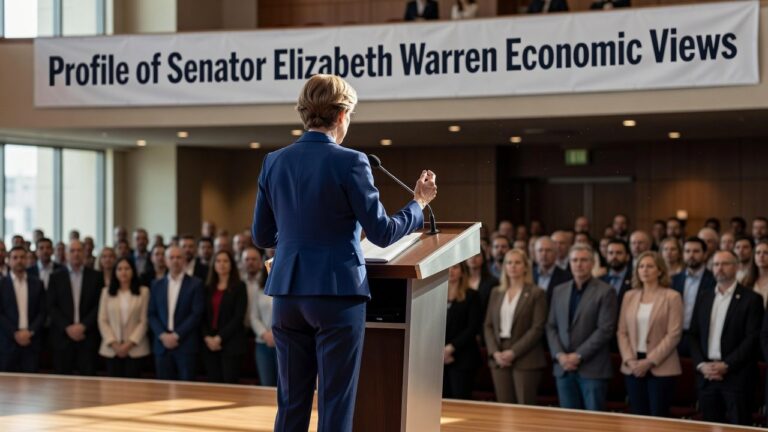

Senator Elizabeth Warren’s approach to economic policy has long shaped debates inside the Democratic caucus, reflecting her decade-plus focus on financial oversight and consumer protections as a senior senator from Massachusetts. Having covered the Hill for a decade, the procedural path she has taken—from academic testimony before Senate banking panels to floor amendments on major reform packages—stands out for its consistency in targeting concentrated market power rather than relying on after-the-fact adjustments.
Warren’s early work examining consumer debt and bankruptcy filings informed her skepticism of creditor-friendly statutes, a perspective that carried directly into her role drafting provisions during the 2010 Dodd-Frank negotiations. That legislative history, stretching back to the post-crisis restructuring of financial regulators, led her to champion the creation of the Consumer Financial Protection Bureau as an independent agency insulated from annual appropriations fights. The bureau’s enforcement record has since returned more than $20 billion to consumers through restitution and penalties.
Her academic foundation proves crucial to understanding Warren’s policy positions. Before entering electoral politics, she spent decades as a Harvard Law School professor studying the economics of household financial distress. This scholarly background gives her economic arguments an empirical foundation that distinguishes her rhetoric from purely ideological appeals. Her research documented how middle-class families filed for bankruptcy at rising rates even as wages stagnated, a pattern she attributes to healthcare costs, childcare expenses, and housing price inflation rather than profligate spending. This data-driven lens informs her conviction that systemic economic problems require structural reforms rather than merely individual behavioral adjustments.
On regulatory questions, Warren has consistently backed measures to revive antitrust scrutiny, including proposals that would scrutinize firms holding more than 30 percent market share in sectors such as technology and pharmaceuticals. These positions align with Democratic efforts in the Judiciary and Commerce committees to strengthen merger review standards and restore labor protections that had eroded under prior administrations. Her 2020 presidential platform included a two-percent annual tax on wealth above $50 million and three percent above $1 billion, provisions that later appeared in modified form in party platform discussions and House-passed reconciliation instructions.
Warren’s approach to Big Tech regulation has proven particularly influential within Democratic circles. She has called for structural separation of dominant technology platforms, arguing that companies like Amazon, Google, and Facebook leverage market dominance across multiple lines of business in ways that harm competition and innovation. Rather than simply imposing fines for violations, her framework would prevent these firms from simultaneously operating as both platform and participant—for instance, preventing Amazon from selling its own products on its marketplace while also collecting data from competing sellers. This preventive approach contrasts with enforcement-focused alternatives and reflects her broader philosophy that concentrated power itself poses problems beyond specific regulatory violations.
The senator has also emerged as a consistent voice on labor market dynamics within Democratic economic discussions. She has supported raising the federal minimum wage to $15 per hour and indexed to inflation, backed the Protecting the Right to Organize Act that would strengthen union organizing rights, and opposed trade agreements lacking enforceable labor standards. These positions reflect her view that wage stagnation stems partly from the erosion of worker bargaining power, a phenomenon she links to inadequate antitrust enforcement and the decline of union membership rates. Her legislative proposals on these themes have attracted support from progressive labor organizations and younger Democratic senators.
Warren’s record shows sponsorship or co-sponsorship of more than 100 measures aimed at economic equity, with over 40 Democratic senators joining her on major financial-reform packages that advanced through the Banking Committee. She has paired these initiatives with support for a public healthcare option, expanded safety-net programs, and trade agreements that embed enforceable labor and environmental chapters—stances that distinguish her voting record from more centrist members while resonating with progressive activists. Her advocacy for Student Loan forgiveness—including her early support for broader debt cancellation—has positioned her as a voice for younger voters grappling with educational debt burdens.
Housing policy represents another area where Warren’s economic philosophy manifests in concrete legislative proposals. She has advocated for increased federal investment in affordable housing construction, rent control protections, and regulations limiting speculative real estate investment. Her perspective connects housing unaffordability to broader wealth inequality patterns, arguing that homeownership has traditionally served as a primary wealth-building mechanism for middle-class families. When that pathway closes due to pricing dynamics, she contends, it perpetuates intergenerational inequality and reduces economic mobility.
The wealth tax proposals that Warren advanced during her presidential campaign deserve particular examination, as they exemplify both her ambitions and the practical complications surrounding progressive economic policy. Her proposed two and three percent annual levies on high-net-worth households aimed to fund universal childcare, student debt cancellation, and expanded Medicare coverage. While economists on the left supported the revenue-raising potential and symbolic message about inequality, some questioned implementation challenges around asset valuation and potential capital flight. The debate itself illustrated how Warren’s proposals often spark substantive policy discussions rather than dismissive rhetoric, a testament to her detailed statutory drafting work.
Critics on the right have characterized these proposals as overreach, yet internal Democratic polling continues to register broad support among primary voters for related items such as corporate tax increases and Medicare expansion. Warren’s ability to translate detailed statutory language into accessible floor speeches has helped keep these priorities visible during budget negotiations and committee markups alike, ensuring they remain part of ongoing legislative drafting rather than abstract talking points. Her effectiveness in committee work—particularly on the Banking, Housing, and Urban Affairs Committee—has generated legislative achievements beyond headline-grabbing floor debates.
Looking across Warren’s tenure, her consistent emphasis on prevention rather than punishment distinguishes her from some Democratic colleagues. Where others might propose stronger post-hoc penalties for corporate malfeasance, Warren typically advocates restructuring market conditions to make such misconduct less likely. This proactive stance reflects her conviction that after-the-fact enforcement cannot adequately protect consumers or workers operating within systems designed to exploit informational asymmetries and power imbalances. Whether through stronger antitrust standards, financial regulatory frameworks, or labor protections, her proposals consistently aim to alter the underlying structural conditions generating inequality rather than simply redistributing outcomes.
Sources
- Reuters – News search for Elizabeth Warren economic policy
- AP News – News search for Elizabeth Warren
- NPR – News search for Elizabeth Warren financial regulation
- Washington Post – News search for Elizabeth Warren
- CNBC – Coverage of Democratic economic policy debates
- Vox – Analysis of Warren’s economic proposals