
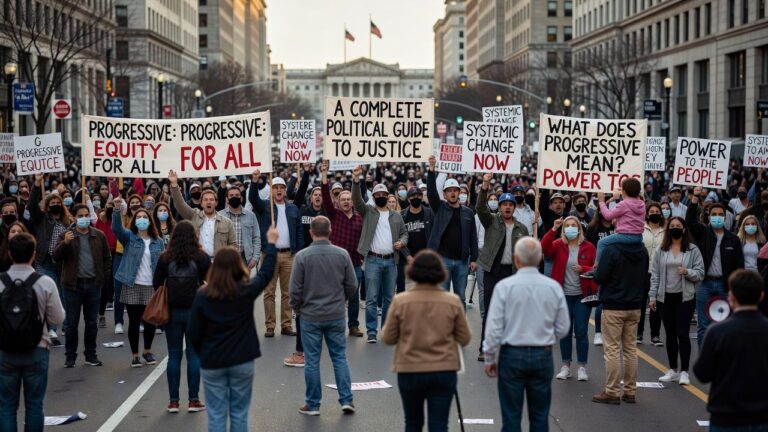
The term progressive has taken on fresh resonance in Democratic circles on Capitol Hill, where lawmakers routinely debate the proper scope of government intervention to tackle inequality and systemic barriers. Having covered these debates for a decade, it is clear that the label now functions less as a slogan and more as a shorthand for a set of legislative priorities that surface in committee markups, amendment votes, and floor proceedings.
At its core, a progressive in contemporary Democratic politics favors active use of federal authority to correct market failures, expand protections for vulnerable populations, and pursue measurable reductions in economic disparity. This approach contrasts with more incremental traditions within the party, yet both camps operate inside the same caucuses and conference negotiations.
The modern usage traces its operational meaning to several recurring commitments that appear in bill text and committee reports: robust regulatory frameworks, evidence-driven appropriations, and expansions of statutory rights in areas such as labor, health coverage, and environmental standards. Legislative history on these points stretches back through the Progressive Era reforms of the early twentieth century, the New Deal authorizations of the 1930s, and the civil-rights and environmental statutes of the 1960s and 1970s. Each period produced durable committee precedents that still shape how contemporary proposals are drafted and scored by the Congressional Budget Office.
The roots of American progressivism run deeper than contemporary partisan labels suggest. The movement emerged in the late 1800s and early 1900s as a response to industrialization, corporate monopolies, and widespread labor exploitation. Figures like Theodore Roosevelt and later Franklin D. Roosevelt championed government intervention as a counterweight to unchecked private power. This historical lineage matters because modern progressives explicitly invoke these precedents when advancing regulatory reforms or antitrust enforcement. The intellectual tradition emphasizes that markets require guardrails, that externalities demand correction, and that concentrated wealth can corrode democratic institutions—arguments that resurface in current debates over tech regulation, pharmaceutical pricing, and banking oversight.
In practice, these priorities surface across multiple policy domains. On economic measures, progressives have backed successive increases to the federal minimum wage and stronger enforcement provisions for the National Labor Relations Act, often through amendments offered in the House Education and Labor Committee. Healthcare proposals frequently include public-option language or Medicare expansion riders, reflecting long-standing efforts that have moved through the Senate Finance and HELP Committees. Climate provisions emphasize binding emissions targets and renewable-energy tax credits, language that has appeared in reconciliation packages and standalone energy legislation. Education and debt-relief initiatives have centered on Pell Grant enhancements and targeted loan-forgiveness authorities, while criminal-justice and immigration measures have sought to codify changes in sentencing guidelines and create statutory pathways to lawful status.
The distinction between progressive positions and moderate Democratic positions often crystallizes around implementation speed and scope. When the Biden administration proposed infrastructure investment, progressives pushed for stricter labor standards and domestic manufacturing requirements, while moderates emphasized bipartisan negotiation and fiscal guardrails. Similar tensions surfaced over the Build Back Better reconciliation package, where progressives advocated for permanent extended child tax credits and lower drug prices, whereas some moderates worried about long-term budget impacts. These aren’t minor disagreements—they reflect fundamentally different views about whether government should actively reshape markets and redistribute resources or work within existing market structures with targeted interventions.
Within the Democratic caucus, the distinction between progressive and liberal members is most visible during leadership negotiations and whip counts rather than on final passage votes. Progressives have at times pressed for more structural changes—wealth-tax frameworks, single-payer architecture, or rapid decarbonization mandates—while liberal colleagues have favored sequenced implementation and deficit-offset mechanisms. Both factions, however, routinely align on must-pass measures, as seen in recent cycles when progressive priorities were incorporated into larger budget reconciliation vehicles.
Understanding progressivism also requires recognizing its relationship to other Democratic ideological strands. While progressives and social democrats often overlap in practice, progressives typically work within the existing American constitutional and economic framework, seeking to reform rather than replace capitalism. Democratic socialists, by contrast, advocate for worker ownership models and more fundamental economic restructuring. Most congressional progressives—members of the Congressional Progressive Caucus and allied groups—operate as left-wing Democrats rather than advocates for socialism, though rhetoric sometimes blurs these distinctions in public discourse. This distinction matters for understanding what progressive legislation actually proposes versus what critics claim it proposes.
The role of grassroots organizations in shaping progressive priorities cannot be overstated. Groups like the Justice Democrats, Indivisible, and various environmental and labor organizations have effectively mobilized voters to pressure Democratic lawmakers on specific commitments. When newly elected progressive representatives like Alexandria Ocasio-Cortez arrived on Capitol Hill, they brought constituencies that had organized around climate action, student debt relief, and healthcare reform. This grassroots pressure from outside groups has also influenced committee agendas, prompting hearings on police accountability and environmental justice that feed directly into legislative text. These developments underscore how the progressive label continues to shape both the substance of Democratic proposals and the procedural pathways they follow through Congress.
Campaign finance also plays a role in distinguishing progressive from moderate Democrats. Progressive candidates often run explicitly against corporate PAC donations and rely instead on small-donor fundraising and digital organizing. This financial independence theoretically allows progressives to take positions opposed by major corporate interests—endorsing stronger antitrust enforcement, higher corporate tax rates, or stricter environmental regulations without concern about losing donations. Whether this advantage translates consistently into actual legislative power remains contested, but it does shape how progressives position themselves within party negotiations.
Looking forward, the progressive movement within the Democratic Party will likely continue to grapple with questions of power and implementation. Progressives have demonstrated the ability to shift Democratic platforms and legislative priorities—compare the 2020 Democratic platform on climate and healthcare to 2016—but translating platform wins into enacted law requires coalition-building and compromise. This fundamental tension between progressive aspirations for structural change and the legislative arithmetic of divided government will shape Democratic politics for years to come. Understanding progressivism means appreciating both its principled commitments to equity and intervention and its pragmatic need to operate within American democratic institutions.