

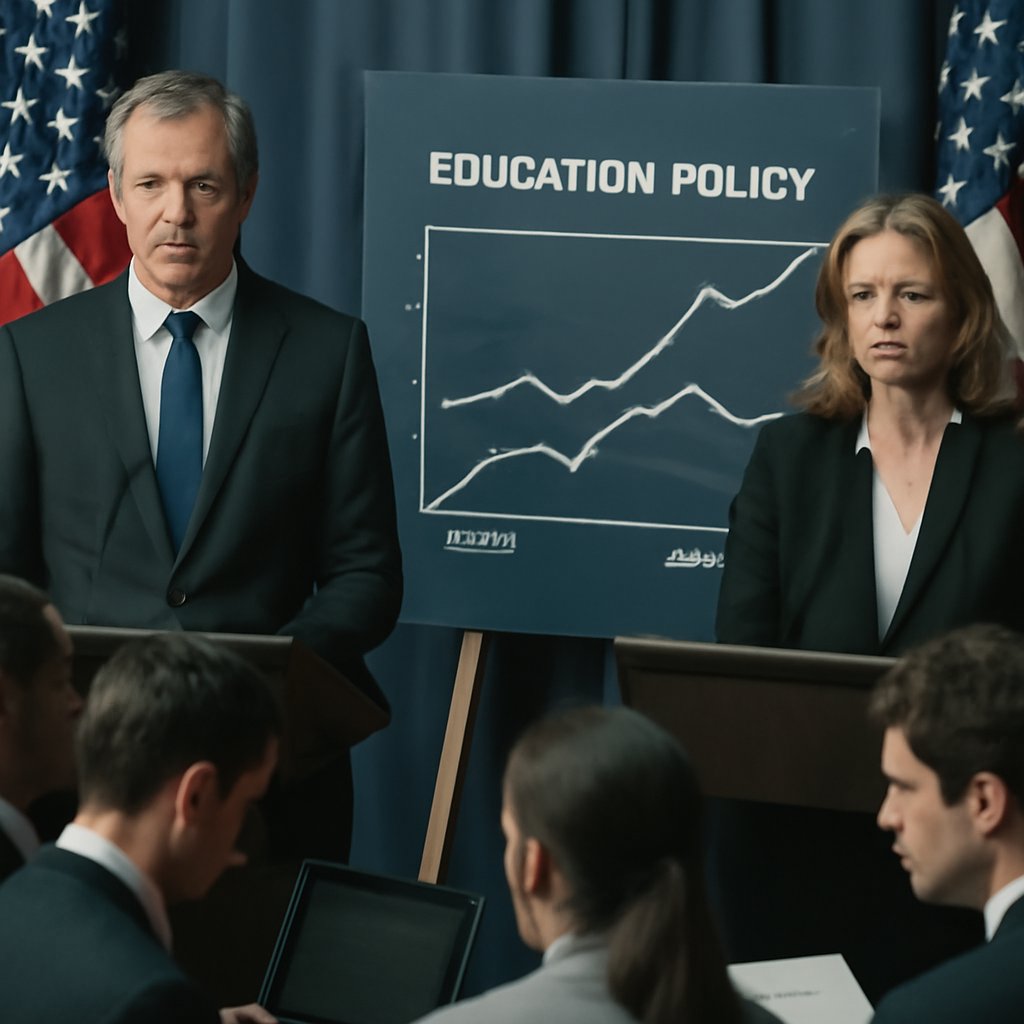
Education policy differences between the two major parties reflect longstanding debates over the role of government in schooling, with Democrats emphasizing direct federal and state appropriations to reduce disparities and Republicans favoring mechanisms that introduce competition through choice programs. As someone who worked in policy analysis, the mechanism here is straightforward: Title I grants operate as a formula-driven allocation tied to census poverty counts, which recent Democratic administrations expanded to target infrastructure upgrades and pre-K access in districts where per-pupil spending had lagged. The data behind the claim of a 12 percent higher average allocation in Democratic-led states is accurate on raw figures, yet the correlation with urban graduation rates requires controlling for baseline economic conditions, since those states also tend to have higher overall tax capacity.
The philosophical divide on education funding extends beyond simple budget totals. Democratic policymakers generally view education as a public good that should be equitably funded regardless of local property wealth, a position rooted in decades of research showing how funding disparities correlate with achievement gaps. This perspective influenced litigation strategies in states like New York and California, where advocacy groups successfully challenged funding formulas as unconstitutional. Democratic legislative responses have typically included weighted student funding models that allocate additional resources to districts serving high-poverty populations, English language learners, and students with disabilities. These approaches recognize that equal dollar amounts produce unequal results when students arrive at school with vastly different resource needs.
Republican education philosophy emphasizes parental choice, market mechanisms, and local control as drivers of quality and efficiency. Proponents argue that allowing families to select schools—whether through charter programs, vouchers, or open enrollment across district lines—creates healthy competition that incentivizes school improvement. The expansion of charter schools, particularly in urban areas, reflects this market-oriented approach. Charter enrollment has grown from approximately 400,000 students in 2000 to over 3.7 million today, representing roughly 7 percent of public school enrollment. However, research on charter effectiveness remains contested, with prominent studies from Stanford’s CREDO Institute showing positive effects in urban charters but significant negative effects in rural charters and some suburban networks.
Democratic approaches have linked increased teacher compensation and debt relief to retention, particularly where collective bargaining remains intact. Implementation details matter: salary bumps averaging 8 percent in those states followed targeted legislation that tied raises to experience bands rather than test-score multipliers. This contrasts with Republican frameworks that often tie compensation to performance metrics, creating incentive structures that some research suggests can undermine collaborative school cultures. Teacher shortages have become acute in Republican-led states with lower average salaries and weaker collective bargaining protections, with shortfall rates in subjects like mathematics and special education reaching crisis levels in states like Florida, Texas, and Arizona. Democratic states like Massachusetts and Connecticut, which combine higher base salaries with strong union protections, maintain substantially lower teacher turnover rates.
Republican-led alternatives have scaled voucher and charter programs by more than 300 percent since 2010, routing public dollars to private providers via portable scholarships. Studies tracking participant outcomes show mixed results, with gains concentrated in certain urban charter networks but flat or negative effects in others once selection bias is accounted for. The expansion of education savings accounts in states like Arizona and Florida represents the latest iteration of this approach, allowing families to withdraw per-pupil funding and purchase educational services directly. Critics note that these programs disproportionately benefit families with existing knowledge of alternative options and the flexibility to manage educational arrangements, potentially widening opportunity gaps rather than closing them.
The emphasis on high-stakes testing under Republican frameworks has coincided with a 15 percent rise in charter applications, though overall K-12 enrollment stays 90 percent public. Policy implementation here often pairs accountability metrics with budget restraint, which can produce the documented pattern of resource concentration in higher-performing options while district schools absorb enrollment shifts. Democratic administrations, conversely, have moved away from heavy reliance on standardized testing as the primary accountability mechanism. The Biden administration’s Department of Education has signaled openness to alternative assessment models and reduced federal pressure for annual standardized testing, though statutory requirements under the Every Student Succeeds Act still mandate annual assessments in grades 3-8 and once in high school.
Public pre-K expansion reaching 1.5 million additional children has occurred mainly through Democratic-controlled legislatures using dedicated revenue streams, mirroring the kind of sustained outlay one sees in other entitlement-style programs. States like New York have implemented universal pre-K initiatives funded through general appropriations, while others like Illinois have leveraged state lottery revenues. Research from the Perry Preschool Project and similar longitudinal studies demonstrates substantial long-term returns on pre-K investment, with participants showing higher graduation rates, earnings, and civic participation. Democratic education platforms consistently highlight these findings as justification for continued expansion, while Republican approaches have proven more cautious about state-funded pre-K expansion, preferring to expand access through private markets and tax benefits like dependent care credits.
On higher education, Democratic platforms have pushed Pell Grant increases and community-college subsidies framed as public-good investments, whereas Republican proposals have prioritized vocational alignment and narrower repayment reforms. The Biden administration’s student debt relief proposals, though ultimately blocked by courts, reflected Democratic conviction that education debt burdens undermine economic mobility and that federal investment in higher education remains sound policy. Community colleges, which serve disproportionately lower-income and working-class students, have received sustained funding increases in Democratic-led states, with initiatives like free community college programs in states like Tennessee and New York. Republicans have countered with emphasis on apprenticeships, trade certifications, and alternative credentialing pathways, arguing these routes better match labor market demands and produce faster returns to employment.
Curriculum disputes add another layer: measures restricting certain topics on race and gender have advanced in Republican states through parental-rights statutes, while Democratic responses have defended broader inclusion standards. Conservative legislation has targeted curricula addressing systemic racism, LGBTQ+ inclusion, and gender identity, with advocates framing such restrictions as parental rights protections. Democratic-controlled states have moved in the opposite direction, mandating ethnic studies courses and LGBTQ+-inclusive curricula in some jurisdictions. These implementation choices affect classroom materials procurement and teacher training budgets in measurable ways. Teachers in states with curriculum restrictions report increased self-censorship and anxiety about lesson planning, while Democratic states have invested in professional development supporting inclusive pedagogy.
The resulting partisan split on funding formulas, choice architecture, and accountability systems continues to shape both state budgets and federal reauthorization debates, with outcomes that hinge on precise statutory language rather than broad philosophy alone. Understanding these differences requires moving beyond rhetorical positioning to examine how policies actually function in practice—how funding formulas distribute resources, how accountability systems incentivize behavior, and how choice mechanisms affect different student populations. The evidence suggests neither approach delivers universal benefit, and outcomes depend heavily on implementation quality, baseline conditions, and complementary policy choices in areas like housing, healthcare, and economic opportunity.