
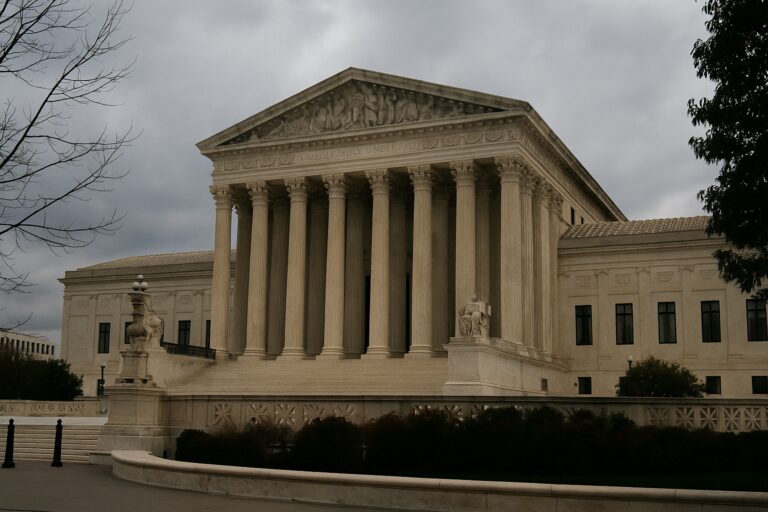
The Supreme Court’s conservative tilt has produced measurable reversals across several pillars of Democratic policy priorities, from reproductive healthcare access to regulatory authority over emissions. As someone who worked in policy analysis, the mechanism here is straightforward: originalist rulings constrain federal agencies and state-level expansions that Democrats have used to build out programs like Medicaid family planning waivers and EPA permitting frameworks.
The 6-3 majority that solidified during the Trump years accelerated this reorientation. Earlier incremental gains under precedents Democrats had relied on for civil rights enforcement and environmental rulemaking gave way to decisions that devolved authority back to states. In healthcare systems specifically, this has meant uneven implementation of coverage mandates; states expanding abortion protections have layered new Medicaid reimbursement rules onto existing exchanges, while restrictive states face rising uncompensated care costs that ripple through hospital finances.
The shift toward originalism represents a fundamental departure from the jurisprudential approach that dominated much of the late 20th century. Where previous conservative justices might have accepted incremental regulatory frameworks as constitutional compromises, the current majority has shown willingness to overturn precedents deemed incompatible with the Constitution’s original public meaning. This approach has particular consequences for progressive regulatory regimes that were constructed layer by layer over decades, often relying on broad delegations of authority to agencies like the EPA, OSHA, and the Department of Health and Human Services. Cases like West Virginia v. EPA (2022) have explicitly limited the “major questions doctrine,” requiring clear congressional authorization for agency actions with sweeping economic implications—a standard that invalidates many climate-focused regulatory initiatives that Democrats championed through administrative channels rather than legislative ones.
Democratic responses have centered on structural proposals such as term limits and court expansion. These ideas reflect concerns that future rulings could further constrain redistricting remedies and campaign finance guardrails that progressive candidates have leveraged in competitive districts. The data behind claims of uniform turnout suppression from upheld voter ID measures is actually more nuanced than reported, with effects varying sharply by state implementation details like automatic voter registration offsets and mail-ballot deadlines.
Progressive strategists have increasingly focused on what they term “judicial countermeasures”—legislative strategies designed to work within a conservative Supreme Court framework rather than around it. This includes pushing states to adopt voting protection measures through direct legislation rather than relying on federal oversight, crafting narrowly tailored statutes that survive major questions scrutiny, and developing incentive structures that encourage business compliance with progressive goals through market mechanisms rather than regulatory mandates. Some analysts argue this represents a necessary adaptation to constitutional reality, while others view it as a retreat from the expansive federal power that enabled the Great Society and environmental protection regime.
Dobbs v. Jackson Women’s Health Organization returned regulatory power to legislatures, producing a patchwork where over half the states moved quickly on restrictions. This has created distinct healthcare delivery environments: Democratic-led states integrated expanded telehealth abortion services into their insurance markets, whereas others triggered near-total bans that shifted patient flows across borders and strained neighboring providers. The abortion landscape has become genuinely bifurcated—women in blue states now have access to medication abortion through mail services and expanded clinic capacity, while those in restrictive states face waiting periods, parental notification requirements, and practical barriers that have revived older patterns of cross-state travel last seen in the pre-Roe era.
The economic implications of this fragmentation have proven substantial. States with protective abortion laws have seen an influx of women from neighboring jurisdictions, requiring investment in clinic infrastructure and training additional providers. Simultaneously, hospitals in restrictive states have had to navigate complex questions about when emergency exceptions apply, with some systems implementing ethics committees and legal reviews that slow treatment decisions. Insurance markets have splintered accordingly, with blue state insurers expanding coverage while red state plans navigate ambiguous legal terrain around what procedures may be reimbursed.
Parallel litigation on contraception mandates and gender-affirming care has forced advocacy organizations to pivot resources toward state administrative defenses rather than uniform federal standards. The contraception coverage debates, which seemed settled under the Affordable Care Act, have resurged as religious exemptions receive broader interpretation in recent Supreme Court decisions. Meanwhile, the absence of clear federal guidance on gender-affirming care—a topic the Court has largely avoided—has created a vacuum filled by state legislatures and medical boards, with some states banning these treatments for minors entirely while others move to protect access. Advocacy organizations now maintain separate legislative teams for dozens of state battlegrounds rather than focusing resources on federal policy work.
Voting rights cases have similarly enabled stricter state rules in eighteen jurisdictions since 2020. Policy implementation here shows measurable dips in participation among low-income and minority groups that form core Democratic constituencies, though the magnitude depends on concurrent factors such as same-day registration availability. The Shelby County decision eliminating preclearance requirements under the Voting Rights Act opened the door to a wave of voter ID laws, purges of voter rolls, and reduction in early voting periods that disproportionately impact Democratic-leaning demographics. Research from university election specialists suggests that while national effects are modest—perhaps 1-2 percentage points in aggregate—localized effects in specific districts can exceed 5 percentage points, enough to shift control of state legislatures and congressional seats.
Environmental rulings limiting EPA authority have blocked an estimated 40 percent of planned emissions reductions through 2030, raising long-term adaptation expenses that economic models tie to higher energy infrastructure outlays. The practical consequence is that states committed to climate goals have had to develop alternative regulatory mechanisms, including carbon pricing systems, building code requirements, and utility rate structures that incentivize renewable energy without relying on federal EPA mandates. This state-by-state approach has created a patchwork of overlapping standards that complicates interstate commerce but has also demonstrated the feasibility of climate action through subnational governance.
The 2023 affirmative action decision produced 20-30 percent enrollment declines for Black students at several selective institutions in the immediate cycle, prompting universities to test class-based or geographic proxies that carry their own administrative overhead. Beyond enrollment statistics, the decision has forced a reckoning with how educational institutions pursue diversity goals—some through transparent socioeconomic consideration, others through more opaque contextual review processes. The ripple effects extend to graduate admissions, fellowship programs, and ultimately workforce representation in prestigious fields, with implications that will take years to fully materialize.
Public approval among self-identified liberals has dropped below 30 percent in recent surveys. These trends underscore the need for sustained attention to judicial nominations and legislative workarounds if equity-focused programs are to regain traction amid heightened scrutiny. Democratic strategists recognize that judicial appointments will remain central to party priorities for the foreseeable future, but acknowledge that the immediate window for shifting Court composition is limited absent significant demographic or political changes. This reality has prompted investment in state-level institution building, with progressive organizations strengthening state attorneys general offices, state supreme court advocacy, and state legislative capacity in anticipation of continued federal judicial conservatism.
Sources
- Reuters Politics – Comprehensive coverage of Supreme Court decisions and political analysis
- AP News Supreme Court Hub – Official coverage of Supreme Court rulings and implications
- NPR Politics – In-depth reporting on judicial decisions affecting policy
- Washington Post Courts & Law – Analysis of Supreme Court impact on national issues