
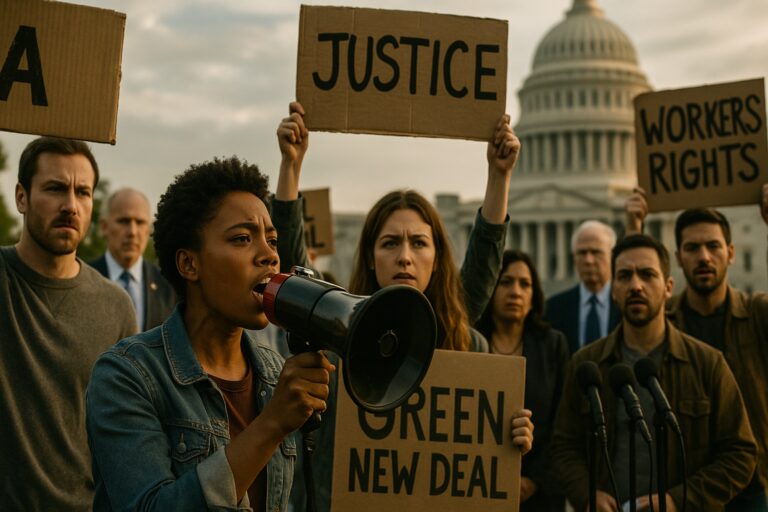

Progressive movements have long exerted influence over Democratic priorities through sustained pressure on committee markups and floor votes, particularly as they intersect with the party’s legislative agenda. Having covered the Hill for a decade, the procedural move here is significant: grassroots demands rarely translate into law without first navigating the House Rules Committee and Senate reconciliation processes that have defined recent sessions.
The legislative history behind this dynamic stretches back to the New Deal, when labor and social reformers compelled Franklin D. Roosevelt to embed Social Security into what became foundational Democratic policy. That pattern repeated with the 1965 Voting Rights Act, where civil rights activism forced party leaders to shift from incrementalism to statutory protections on racial equity, altering committee jurisdictions in both chambers for generations. The same pressure mechanics resurfaced during the Great Society, when movement activists successfully demanded the Fair Housing Act of 1968 and expanded antipoverty programs that Democrats had initially proposed in more limited form.
Grassroots organizations, including the Congressional Progressive Caucus, have amplified these efforts by coordinating at the district level and targeting vulnerable members ahead of primary challenges. Their town halls and petition drives routinely surface issues like wealth inequality that establishment leadership might otherwise sideline during closed-door negotiations. The infrastructure supporting these campaigns has grown considerably, with digital organizing platforms now enabling rapid constituent mobilization that can shift voting behavior within legislative windows measured in days rather than months.
In the 2020 cycle, youth-led groups such as the Sunrise Movement succeeded in elevating Green New Deal provisions during presidential primaries, which later informed Democratic platform language on emissions reductions and renewable investments. Black Lives Matter activism following the same period similarly elevated criminal justice provisions, shaping both campaign messaging and subsequent committee hearings on police reform. These efforts tie electoral viability directly to legislative responsiveness, as evidenced by the Caucus’s expansion from roughly seventy members in 2018 to more than one hundred today, granting it greater sway over subcommittee assignments and amendment opportunities.
The mechanics of how progressive movements translate grassroots energy into legislative outcomes deserve closer examination. When organizations like the Sunrise Movement stage sit-ins at congressional offices or coordinate mass phone-banking campaigns targeting specific lawmakers, they create a political cost for resistance that extends beyond traditional polling margins. Democratic leaders recognize that primary challenges funded by movement-aligned PACs and supported by energized volunteers pose genuine threats to incumbents in safe districts—a dynamic that fundamentally altered behavior around climate legislation and social spending priorities between 2018 and 2023.
The role of social media and digital organizing cannot be overstated in this evolution. Progressive movements now leverage platforms to rapidly amplify constituent demands, creating viral moments that dominate news cycles and force leadership responses. A single tweet or TikTok video showcasing a member’s vote against progressive priorities can generate thousands of comments demanding explanations, establish primary challenger narratives, and influence local media coverage in ways that traditional organizing simply cannot match. This technological advantage has shifted power dynamics within Democratic primaries, where younger, more energized voters now possess tools to hold establishment-aligned candidates accountable in real time.
Tangible outcomes include the expanded child tax credit provisions enacted in 2021 and ongoing student debt relief proposals, where Democratic leadership now routinely incorporates input from movement-aligned members to avoid internal fractures. The Inflation Reduction Act’s $370 billion in clean energy investments, secured after sustained advocacy during Senate Finance Committee deliberations, further illustrates how progressive amendments can survive reconciliation procedures. Beyond headline figures, progressive insistence on direct investments in environmental justice communities rather than market-based mechanisms alone shaped how these funds ultimately flowed to disadvantaged neighborhoods most impacted by pollution and climate risk.
Student debt relief exemplifies the sustained pressure mechanism particularly well. For over a decade, progressive organizations maintained this issue as a priority despite Democratic establishment reluctance to embrace full forgiveness. President Biden’s eventual student debt cancellation announcement in 2022, while narrower than many progressives demanded, represented a significant policy shift that would have been unthinkable without years of sustained grassroots organizing, petition drives, and primary threats against hesitant Democrats. The political calculus shifted as younger voters increasingly weighted this issue in their electoral decisions.
Moderates within the caucus have pushed back on more ambitious items such as Medicare for All, citing risks to swing-district members, yet framing through economic populism has allowed incremental progress. This tension between progressive ambition and electoral pragmatism has produced a distinctive Democratic legislative approach: expansions of existing programs rather than wholesale replacements, tax credits rather than direct government provision, and incremental increases in funding rather than transformative restructuring. While progressives view these as insufficient, they represent genuine victories achieved through leverage rather than compromise.
The primary election system functions as the primary mechanism through which progressive movements maintain pressure on Democratic officeholders. Unlike general elections, where swing voters theoretically occupy the center, Democratic primaries are dominated by voters who care deeply about progressive issues. A well-funded primary challenge or threat of one, combined with grassroots mobilization, can convince vulnerable incumbents that supporting progressive legislation is politically safer than opposing it. This dynamic became particularly evident in 2022 and 2023, when several moderate Democrats facing potential primary challenges shifted positions on climate and social spending legislation after grassroots organizing efforts in their districts.
Looking toward 2024, organizers are prioritizing turnout operations in key districts where reproductive rights and housing affordability remain flashpoints, ensuring these issues receive priority in upcoming authorizing and appropriations cycles. Recent Pew data showing over 70 percent of Democratic voters under 35 aligning with movement priorities, combined with 12 states passing climate ballot measures and 15-to-20 percent turnout gains in heavily mobilized districts during 2022, underscore the electoral math that continues to reward responsiveness on these fronts.
The housing crisis presents a particularly instructive case study in how progressive movements are reshaping Democratic policy priorities. Where the party once avoided confronting landlord interests and development lobbies, movement pressure has compelled Democrats to embrace zoning reform, tenant protections, and affordable housing mandates that challenge traditional real estate industry positions. Progressive organizations coordinating at city council, state, and federal levels have shifted the debate from whether to intervene in housing markets to what form that intervention should take—a fundamental reframing that would have seemed politically impossible a decade ago.
Reproductive rights organizing following the 2022 Supreme Court Dobbs decision similarly demonstrates how movement momentum can rapidly reshape legislative agendas. Progressive groups that had maintained abortion access as a priority through years when establishment Democrats were hesitant to lead found their messaging vindicated when this issue drove unexpected Democratic gains in 2022 midterms. The subsequent shift toward more assertive pro-choice positioning and federal action represents movement vindication and suggests that Democrats now perceive reproductive rights as a core electoral issue rather than a secondary concern.
The sustainability of progressive influence depends partly on whether movement organizations can maintain membership engagement and funding between election cycles. Groups that peak during presidential years and fade during midterms or local elections risk losing leverage, as Democratic leadership attention follows electoral cycles. Successful organizations like the Sunrise Movement have worked to sustain member engagement through consistent local programming, issue escalation, and candidate accountability efforts that maintain pressure regardless of electoral calendar. This infrastructure-building represents a maturation of the progressive movement beyond episodic mobilization.