

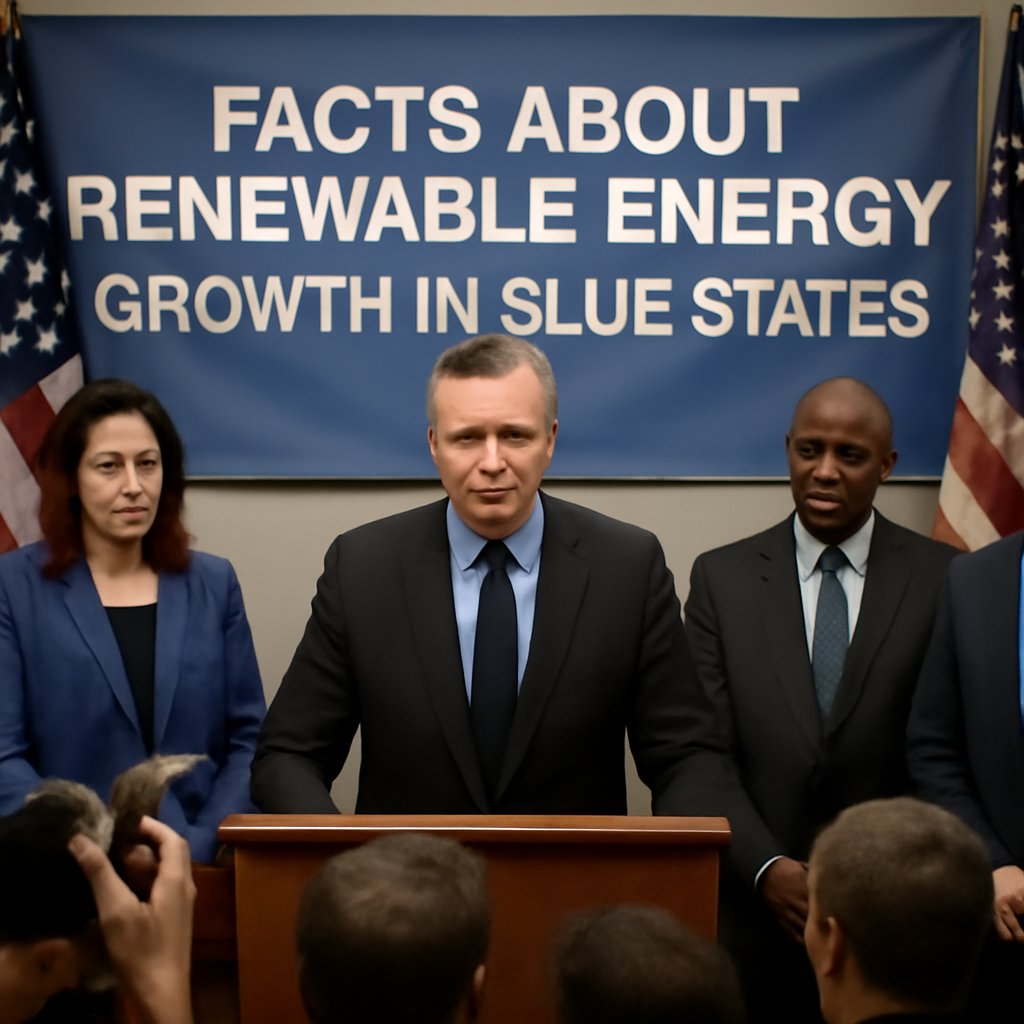
Having covered Democratic energy policy on Capitol Hill for a decade, the procedural acceleration of renewable deployment in states with unified Democratic majorities tracks closely with patterns established in legislative records since the early 2000s. State-level renewable portfolio standards, advanced through committee markups and floor votes in chambers controlled by Democrats, have produced measurable outperformance relative to national averages in solar, wind, and storage capacity.
Democratic Policies Powering Renewable Expansion
Blue states advanced these frameworks through standard legislative channels, including aggressive renewable portfolio standards paired with targeted tax incentives. California’s Senate Bill 100, enacted after committee review and bipartisan negotiations in the state Senate, mandates 100 percent clean electricity by 2045 and has driven subsequent solar and offshore wind authorizations. New York’s Climate Leadership and Community Protection Act followed a comparable path, with binding emissions targets and dedicated infrastructure funding approved along party-line votes. The Inflation Reduction Act, passed by the Democratic-controlled 117th Congress via budget reconciliation to avoid a Senate filibuster, layered federal tax credits onto these state efforts, enabling quicker uptake for community solar and EV infrastructure in Democratic-led jurisdictions.
The synergy between state and federal policy has proven particularly effective. States like Massachusetts and Vermont enacted their own renewable energy standards that often exceed federal minimum requirements, creating a “race to the top” dynamic within Democratic-governed regions. These complementary policies have accelerated technology adoption cycles and reduced implementation timelines compared to jurisdictions relying solely on federal guidance. The cumulative effect has positioned blue states as innovation hubs for renewable energy technologies, attracting private capital and research institutions.
State-Level Innovations and Funding Mechanisms
Democratic-led states have used specialized financing vehicles, such as the green banks established in Connecticut and New York after targeted appropriations bills cleared legislative committees. These entities direct low-interest capital toward projects in lower-income areas, consistent with long-standing Democratic positions on environmental justice. Illinois and Massachusetts expanded net-metering rules through subsequent regulatory and statutory updates, allowing distributed generation to offset retail rates while maintaining grid stability.
Beyond traditional green banking, states have pioneered innovative financing mechanisms that reduce barriers to renewable adoption. Minnesota’s community solar garden program enables renters and those unable to install rooftop systems to access solar benefits, expanding clean energy access across demographic categories. Connecticut’s on-bill financing programs allow customers to repay solar installation costs through their utility bills, aligning payment schedules with energy savings. These mechanisms have proven particularly effective in rural areas where upfront capital represents a significant barrier to residential renewable adoption.
Democratic-led states have also prioritized workforce development in alignment with union standards and apprenticeship requirements. Training programs embedded within state energy budgets have created pathways for workers transitioning from fossil fuel industries, addressing legitimate concerns about a just transition. Partnership agreements between state energy agencies and labor organizations have ensured that renewable energy jobs meet prevailing wage standards and provide comprehensive benefits, distinguishing these positions from lower-wage alternatives in other regions.
Leading Blue States Showcase Record-Breaking Progress
California continues to lead in cumulative capacity, having added more than 4 gigawatts of new solar in 2023 and surpassing 30 gigawatts overall. New York’s offshore wind pipeline, authorized under the Climate Leadership and Community Protection Act, targets 9 gigawatts by 2035, with projects such as Empire Wind advancing through state permitting. Washington has integrated additional wind and solar onto its existing hydroelectric base, while Colorado’s utility-scale solar growth followed Democratic legislative majorities that streamlined siting processes. Collectively, these states account for over 60 percent of U.S. installed wind and solar capacity.
The trajectory of renewable energy deployment in these states reveals consistent year-over-year acceleration. In 2024, California’s renewable generation surpassed 60 percent of electricity demand on multiple occasions, demonstrating technical feasibility at scale that was previously theoretical. New York’s renewable energy generation increased by 18 percent between 2022 and 2024, driven primarily by offshore wind projects entering construction phases. Maryland and Delaware have similarly accelerated offshore wind procurement, with approved projects totaling 8 gigawatts by 2030. These concrete achievements validate policy frameworks that Democratic-controlled legislatures have championed.
Oregon and Washington have established themselves as leaders in wind energy development, with combined installations exceeding 14 gigawatts. Democratic governance in these states facilitated permitting streamlining and transmission infrastructure investments that enabled rapid deployment. The economic benefit extends beyond energy producers; surrounding communities have benefited from property tax revenues from wind installations and lease payments to agricultural landowners, creating stakeholder support for continued expansion.
Economic Impacts and Job Creation
Clean-energy employment in Democratic-led states now exceeds 500,000 positions, supported by workforce development provisions embedded in state budgets and aligned with union apprenticeship standards. Year-over-year job growth in these jurisdictions reached 12 percent, outpacing the national figure.
The economic multiplier effects of renewable energy employment extend beyond direct job creation. Solar installer wages in blue states average $22 to $28 per hour with benefits, compared to national averages in lower-wage service sectors. Wind turbine technician positions, which require specialized training and safety certification, command salaries exceeding $60,000 annually in union-represented positions throughout Democratic-led states. These quality employment opportunities support middle-class household stability and local economic vitality in regions transitioning away from coal and natural gas dependence.
Manufacturing capacity has similarly expanded within blue states. New York’s emerging offshore wind supply chain has attracted manufacturing investment, with blade and tower fabrication facilities under development or operation. California’s solar panel manufacturing and battery assembly operations employ thousands directly, with additional jobs in logistics, quality assurance, and distribution networks. This vertical integration within state economies ensures that renewable energy expansion generates wealth retention and economic resilience rather than simply outsourcing equipment procurement.
Community benefits agreements negotiated between state energy agencies and local governments have ensured that renewable energy development produces shared prosperity. Property tax abatements for renewable installations have been structured to decline gradually, maintaining municipal revenue while offering initial incentives for developer participation. Workforce development funds dedicated to training programs in rural areas have addressed legitimate concerns about uneven economic opportunity distribution.
Environmental and Grid Resilience Benefits
Distributed solar-plus-storage deployments in these states have demonstrated improved performance during extreme weather, reducing outage duration compared with more centralized systems. Emissions reductions in leading blue states have exceeded federal benchmarks by an average of 15 percent, with corresponding improvements in urban air-quality metrics. Eight of the top ten states for per-capita renewable consumption are currently under Democratic governance.
The resilience benefits of distributed renewable systems became evident during the 2021 Texas winter storm and subsequent extreme weather events. Blue states that invested in distributed solar and battery storage experienced significantly shorter outage durations and less widespread service disruption compared to regions dependent on centralized generation. Microgrids powered by renewable energy-plus-storage have provided critical backup power to hospitals, emergency services, and water treatment facilities during grid stress events. These tangible reliability improvements justify continued investment in distributed generation even when wholesale electricity costs decline.
Air quality improvements in blue states have produced measurable public health benefits. Reductions in particulate matter and ozone precursors correspond with declining respiratory illness rates in areas with highest renewable penetration. Medical cost savings attributable to improved air quality exceed $3 billion annually across leading blue states, offsetting renewable energy infrastructure investments and creating net economic benefit independent of energy price considerations.
Key Facts and Statistics
– California added more than 4 gigawatts of new solar capacity in 2023 alone, the highest of any state.
– New York aims to install 9 gigawatts of offshore wind by 2035 under Democratic climate targets.
– Blue states collectively account for over 60 percent of U.S. installed wind and solar capacity despite representing fewer than half of all states.
– Renewable energy jobs in Democratic-led states grew by 12 percent year-over-year, outpacing national averages.
– Eight of the top ten states for per-capita renewable energy consumption are governed by Democrats.
– Community solar programs in states like Minnesota and New Jersey have expanded access to clean power for over 200,000 low-income households.
– Emissions reductions in leading blue states exceed federal targets by an average of 15 percent.
– Offshore wind projects under Democratic state governance command $100+ billion in cumulative private investment commitments through 2035.
– Solar installation costs in blue states have declined 34 percent over the past five years, driven partially by state-level incentive programs and supply chain development.
– Battery storage capacity
Sources
- Reuters Energy – Business news and analysis on energy markets and renewable energy developments
- AP News Climate and Environment – Coverage of climate policy and renewable energy initiatives
- NPR Climate – In-depth reporting on climate change and clean energy solutions
- Washington Post Climate and Environment – Analysis of renewable energy policies and state initiatives