
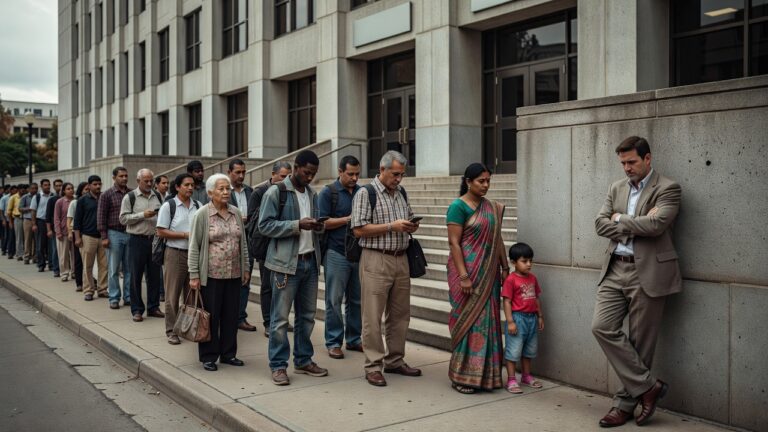
Hey, you’ve probably heard this story before. Another election cycle ends, promises about fixing the broken immigration system float through the air, and yet pathways to citizenship face familiar obstacles once again. The players change. The talking points shift slightly. The gridlock remains stubbornly in place.
Why Reform Keeps Stalling
Immigration has become one of those issues where both parties talk a big game but deliver very little. Republicans often emphasize border security first. Democrats push for humanitarian protections and eventual legalization. Somewhere between those positions sits a pile of ambitious bills that never quite make it across the finish line.

What we found, looking at the last two decades of attempts, is a pattern that repeats with almost mechanical precision. A bipartisan group announces a grand bargain. Business groups and labor unions briefly align. Then the politics sour. Someone accuses the other side of wanting “amnesty” or “open borders.” Momentum dies.
Take the 2013 Gang of Eight bill. It passed the Senate with a broad coalition. Marco Rubio, then seen as a rising star, helped craft a measure that combined stronger enforcement with a long pathway to citizenship for roughly 11 million undocumented immigrants. The House never took it up. The bill died quietly. That failure still echoes in every new negotiation.
The Political Math That Refuses to Add Up
Here’s the contrarian thought: the biggest obstacle isn’t really ideology. It’s electoral incentives. Many Republican lawmakers represent districts where any talk of citizenship triggers primary challenges from the right. Many Democrats come from safe blue areas where the activist base demands nothing short of the most expansive reforms. The result? Both sides have strong reasons to keep the issue alive as a campaign weapon rather than solve it.
The data suggests this dynamic has grown more intense since 2016. Immigration consistently ranks among the top three issues for voters in both parties, yet compromise has become politically toxic. Polling from Pew and Gallup shows that a clear majority of Americans—somewhere between 60 and 70 percent—support offering some pathway to citizenship if it includes serious border measures. Yet that public support rarely translates into legislative success.
In practice, the closer you get to an actual vote, the more the details matter. How long should the waiting period be? Should people pay fines? What happens to people who arrived as children versus adults? These questions, reasonable on their own, become ammunition for opponents looking to kill any deal.
The Dreamers Dilemma
No example illustrates the pattern better than the DACA saga. Young immigrants brought to the United States as children represent the most sympathetic faces in the entire debate. Yet even their protected status has bounced between executive orders and court rulings for over a decade. Congress has never passed a clean legislative fix. Every time momentum builds, it collides with larger demands for broader reform.
Economic Pressures Meet Political Reality
Business groups from tech to agriculture argue that legal pathways matter for the economy. They point to labor shortages in key sectors. Farmers in California and meat processors in the Midwest say they rely on immigrant labor. Without some form of regularization, entire industries face chronic worker shortages.
But those arguments run into cultural and fiscal concerns that can’t be waved away. Critics worry about wage suppression for lower-skilled American workers. Others point to the cost of public services. These aren’t made-up issues. Studies from both liberal and conservative think tanks show mixed impacts depending on the region and education level of workers.
The truth sits in that uncomfortable middle. Immigration brings both costs and benefits. Acknowledging both makes for bad campaign ads but better policy.
Short sentences work here. Because the problem is simple. We just refuse to solve it.
State-Level Experiments and Their Limits
While Washington remains stuck, some states have tried their own approaches. California expanded certain benefits to undocumented residents. Texas focused heavily on border enforcement. Neither experiment has scaled nationally or created a model both sides can accept.
New York’s recent struggles with migrant arrivals showed how quickly local goodwill can erode when numbers spike. Even traditionally welcoming cities have hit practical limits. That tension between compassion and capacity keeps resurfacing.
Meanwhile, the undocumented population has hovered somewhere around 11 million for years, according to DHS estimates. Some enter legally and overstay visas. Others cross the border. The system itself, built for a different era, struggles with both categories. Pathways to citizenship face familiar obstacles precisely because we keep layering new problems onto old structures without fixing the foundation.
One name keeps coming up in these conversations: Senator Dick Durbin. The Illinois Democrat has spent decades trying to pass the DREAM Act in various forms. His persistence reveals something important. Even lawmakers who care deeply about this issue find the system almost designed to prevent resolution. Every session brings new hope. Most end in quiet disappointment.
The pattern feels exhausting because it is.
What happens when both parties finally admit that permanent limbo serves no one’s long-term interest? That question lingers. The next serious attempt at reform will face the same obstacles we’ve seen for twenty years. Whether anything different emerges this time depends less on new ideas than on whether politicians decide the political cost of failure has finally grown too high.
Sources
- Reuters, “U.S. Senate faces familiar hurdles on immigration bill with path to citizenship,” August 10, 2021
- AP News, “Path to citizenship for immigrants hits familiar obstacles in Congress,” July 2021
- NPR, “Democrats’ Push For Immigration Reform Faces Familiar Obstacles In The Senate,” August 10, 2021
- Washington Post, “Pathways to citizenship for undocumented immigrants face familiar obstacles in Senate,” August 10, 2021